I was drawn to Quakers in the first place, because (unlike my Mormon uncles, or the inmates of any traditional church) they were reticent about God, hesitant to put words in God's mouth or tell him at great length what they expected of him. And also because my best friend dragged me there. Why should an atheist come to Meeting?–because my friend asked, and if God was going to exist despite all the good reasons I knew otherwise, I'd give him a chance to get in a word or two on his own behalf. I went once, had a nice experience; but God didn't tell me he'd been there, and so I didn't feel it right to return. What happened between me & God developed elsewhere, in its own time.
[I use the G word- -It's been misused a lot, but it's what we've got for the purpose. (If I say "he," you're welcome to say "she" or "ge" or anything that does it for you.) Some of the difficulties are simply in the nature of things; an honest effort to understand how we exist, rather than Nothing-with-nobody-to-notice-it, sometimes just makes me dizzy! It's not just-us; it's not other-than-us either, but what humans call paradox and mystery is simply the way things are.]
I visited meetings several times over the years, and always went away feeling that I didn't belong; that "They aren't doing this right!" or that "I have nothing to contribute here, no money and I don't do marvelous Good Works." There was even an apocalyptic time in 1970 when I sat with a student worship group, and felt an invisible presence in the doorway: "Why Forrest," it asked, "What are you doing, trying to hide among the good people?"
I returned in 1991, after I'd been roped into a campaign for the rights of homeless people. Enlisted at last with the angels, I expected to find other people intending to devote themselves to God. Some of the people at meeting did join in demonstrations, were helpful in various ways. Worshiping with the group felt right. But there was something I didn't understand about it.
It's that culture of silence.
Talk puts barriers between people, and silence can be a way to bypass them. Talk can hide God behind a verbal image, which silence may dissolve. But silence is a double-edged sword.
Silence also puts barriers between people. Refusal to talk about God shuts us off from learning ways of recognizing him.
In the Bible, Adam is not necessarily created male or female. But at some point, God says, "It is not good for the man to be alone." We could have been one person alone, communing with God and living in Paradise as if it were a vacant lot. It wasn't what God had in mind, when he made this world and called it "good."
We find God in ourselves, if we're going to find him anywhere at all. There's no "corporate worship" unless we parts of the body go into worship ourselves. But we come together for the occasion because we weren't made to be so alone.
Silence is the "plain dress" of contemporary Quakerism. It's become a "poor silly gospel" that risks taking the place of its actual purpose.
Remember the "parable of the talents"? The master distributes money for his servants to hold while he's traveling. Two servants find uses for the money, and return more than they were given. The third buries it in the back yard, and when the master sees that his servant is only returning the original deposit, there's the usual wailing & gnashing of teeth. "To he who has much, more will be given, but he who has little will find even what he has taken away;" that's the moral we're given. But what was "little" here?-- the gift, or the willingness to use it?
Since a few spiritually connected old members have died, the messages in my meeting have dwindled to the point that our Ministry & Oversight committee was concerned about the lack, a year or so before my own term there. Are we merely short of spiritual gifts?-- or have we been practicing a sort of spiritual stinginess that leads to us receiving little?
I've always had misgivings about our "state of the meeting" reports, considered them empty formalities, our annual exercise in denial. This year was different. Our Yearly Meeting ministry committee was suggesting that local meetings treat this year as a jubilee, a long sabbath, an occasion for discernment of what we were doing, and whether all of it was really necessary. That recommendation may have been influential, was certainly in the background. Also, the report had been left in the hands of two aging members, the third of the committee having left unexpectedly for Costa Rico. Not knowing what to say about us, certainly not about "our spiritual condition," they followed the example of nearby La Jolla Meeting and scheduled a potluck "talking meeting" to learn what our meeting members could say about themselves.
At the potluck, we found the meeting sharply divided between "Our meeting is just fine, so please shut up!" vs "We wouldn't know a ‘spiritual condition' if it bit us!" The report even reflects this division. But it isn't only the report. The value of preparing the report is to bring a meeting's attention to its situation. Doing this, we've also agreed to continue examining and working on the divisions between us. Before and after-meeting study & sharing groups are starting up again, with new members interested in attending.
Why does that make me hopeful? I had a message last week. For years I've felt oppressed with a sense of being given important things to say to my meeting, but without the ability to make them palatable. And lately I've sometimes been telling myself, "I have nothing to say to these people!" This last week, I simply told them "I don't know what to say to you because I don't know where you are!" Right, wrong, welcome, unwelcome? It was an uncomfortable thing to say. But between the silence of the meeting and the chatter of after-meeting refreshments, it's been damned hard to know a lot of us very deeply.
As someone once said, "If this is a true message, you know it too." I was very surprised, during refreshments, when one of the old members came up and thanked me. I don't know how this will turn out, but we're letting something new happen.
As for me, I can know God by myself. But when I keep it to myself, it goes nowhere and I get stuck. When I find ways to share what I've learned, other people can share what they're learning. Once talking, I don't easily shut up enough to hear them well. But I'm learning. And when this happens, God brings out a lot more for me to understand.
Is a conversation only "listening"? Only "talking"? Is a meeting only silence, or only messages? Can we bring our souls out of the closet for refreshments, share the meat of Christ's words between us? I see it beginning here. Is this something other meetings need as well?
Thursday, April 26, 2007


Friday, February 02, 2007
a nice little poem
Dear Civilization
I'm running a fever like the Earth
to cure the sickness of your medicines
You splash filth in my eyes
and think I do not see
My lungs clog with your fires
and my mouth with your murders,
my throat with honest vomit.
I refuse your treatments; my heart
drifts down the river strewing daisies
and singing.
I'm running a fever like the Earth
to cure the sickness of your medicines
You splash filth in my eyes
and think I do not see
My lungs clog with your fires
and my mouth with your murders,
my throat with honest vomit.
I refuse your treatments; my heart
drifts down the river strewing daisies
and singing.
Thursday, February 01, 2007
Prayer?
It's the season, if that still helps, for being sick, at least where I live. A couple of weeks of unaccustomed cold weather and a couple of nights of lying mostly (more-or-less) awake listening to my gizzards and wondering when will they let me relax, followed by last night's sore throat (in perfect sync with Anne this time) providing at last an explanation why a moderate amount of perfectly good (even yummy) food was doing this to me.
It keeps the old immune system in practice, on the level of physical causation. I guess this game of physical causation serves some spiritual purpose; I mean that the discomfortable details of it and the scarcity of sexually oblivious whee seem to require more explanation than the nice blissful bits; and while the notion of God at eternal play has its appealing side, it also carries a nasty hint of "Oh shit! Eternity again! What can I do now?"--which I hope is merely my own emotionally-jaundiced take rather than the actual Divine Condition...
A new way to play Prayer... if there is such a thing--anyway, newish to me. (By the way, I'm also finding out that tempera, meaning playing with egg in my paints, is utterly wonderful (as well as frustrating when big chunks of lovely luminous color peel off and leave yucky chaos; I'll let you know how it works when I get a little more experience myself))!!
Should one play Prayer? My experience has been, what I play at I do again, and get better at. We'll see.
There's all this "counting the breath" stuff, which helps some people get there. Sometimes it gets even me more there. Then there's counting heartbeats--which has the virtue of letting one's breath alone so it isn't so much at the mercy of my expectations of How It Should Be Done. Traditional zen practice was to count breaths 1-10, then start over at 1. But modern computer practice goes 1-9, then a-f, then 10 (stands for "16" in the usual number system), 11, 12... 1a-1f, 20, whee! (Mathematicians are weird; get used to it!)
But really we've got the whole alphabet available. Which takes us up to "base 36," meaning that when you count "z" and prepare to say 10, you have actually counted what we normally call 35 breaths and are about to count the 36th. More symbols than that would be too complicated, but we have that old verse for remembering how alphabetical order goes... We can count up to a fairly big number this way, without many digits. Rather than being pedantic about exactly how many breaths we're actually counting (which doesn't in itself matter) we can say 10 as 1,0 followed by 1,1 and 1,2 on up to 1,z and 2,0 and beyond to z,z & on past 1,0,0 if we're really obsessive about this.
Anyway. However large or small the number you choose to count up to (and you might vary that, why not?) there is a tendency to drift off into just normal inattentive thinking, the sort you were trying to avoid being looped-into in the first place.
You can just address some remarks to God, in your mind. One word per heartbeat.
You probably, so far as you're like me, wonder what to say. Okay, blather something quick & banal and then take a break--by counting awhile. When you reach your intended goal, say more. Repeat as needed.
All right, you don't tell God anything this way he doesn't already know.
But you now have something to do while wondering "What can I possibly find to say next?" And then you get the pressure of having to "say" something at THIS moment, followed by a more contemplative counting break.
I find myself saying utterly childish things. It's all right; God is used to me. It is not what God needs to hear but what I need to address to God, what comes out when I'm trying at short notice to say whatever I actually mean... I get to hear what I really mean, and that seems a good thing.
Maybe these blurts should all be pious. I don't think so. I mean, yes, love and gratitude and praise are good, appropriate things to feel but sometimes I don't, and it may be better just to say "My-throat-hurts-and-I-don't-know-what-I-should-be-say-ing-but-I-guess-I'm-glad-I'm-here-Thanks-for-Anne" and so on. With every beat of my silly heart. It gets me though the Long Dark Night of the Tummy. And some day, who knows, it might just make me better.
It keeps the old immune system in practice, on the level of physical causation. I guess this game of physical causation serves some spiritual purpose; I mean that the discomfortable details of it and the scarcity of sexually oblivious whee seem to require more explanation than the nice blissful bits; and while the notion of God at eternal play has its appealing side, it also carries a nasty hint of "Oh shit! Eternity again! What can I do now?"--which I hope is merely my own emotionally-jaundiced take rather than the actual Divine Condition...
A new way to play Prayer... if there is such a thing--anyway, newish to me. (By the way, I'm also finding out that tempera, meaning playing with egg in my paints, is utterly wonderful (as well as frustrating when big chunks of lovely luminous color peel off and leave yucky chaos; I'll let you know how it works when I get a little more experience myself))!!
Should one play Prayer? My experience has been, what I play at I do again, and get better at. We'll see.
There's all this "counting the breath" stuff, which helps some people get there. Sometimes it gets even me more there. Then there's counting heartbeats--which has the virtue of letting one's breath alone so it isn't so much at the mercy of my expectations of How It Should Be Done. Traditional zen practice was to count breaths 1-10, then start over at 1. But modern computer practice goes 1-9, then a-f, then 10 (stands for "16" in the usual number system), 11, 12... 1a-1f, 20, whee! (Mathematicians are weird; get used to it!)
But really we've got the whole alphabet available. Which takes us up to "base 36," meaning that when you count "z" and prepare to say 10, you have actually counted what we normally call 35 breaths and are about to count the 36th. More symbols than that would be too complicated, but we have that old verse for remembering how alphabetical order goes... We can count up to a fairly big number this way, without many digits. Rather than being pedantic about exactly how many breaths we're actually counting (which doesn't in itself matter) we can say 10 as 1,0 followed by 1,1 and 1,2 on up to 1,z and 2,0 and beyond to z,z & on past 1,0,0 if we're really obsessive about this.
Anyway. However large or small the number you choose to count up to (and you might vary that, why not?) there is a tendency to drift off into just normal inattentive thinking, the sort you were trying to avoid being looped-into in the first place.
You can just address some remarks to God, in your mind. One word per heartbeat.
You probably, so far as you're like me, wonder what to say. Okay, blather something quick & banal and then take a break--by counting awhile. When you reach your intended goal, say more. Repeat as needed.
All right, you don't tell God anything this way he doesn't already know.
But you now have something to do while wondering "What can I possibly find to say next?" And then you get the pressure of having to "say" something at THIS moment, followed by a more contemplative counting break.
I find myself saying utterly childish things. It's all right; God is used to me. It is not what God needs to hear but what I need to address to God, what comes out when I'm trying at short notice to say whatever I actually mean... I get to hear what I really mean, and that seems a good thing.
Maybe these blurts should all be pious. I don't think so. I mean, yes, love and gratitude and praise are good, appropriate things to feel but sometimes I don't, and it may be better just to say "My-throat-hurts-and-I-don't-know-what-I-should-be-say-ing-but-I-guess-I'm-glad-I'm-here-Thanks-for-Anne" and so on. With every beat of my silly heart. It gets me though the Long Dark Night of the Tummy. And some day, who knows, it might just make me better.
Sunday, January 28, 2007
A Piece for Quaker-L
As I said during in a recent fuss, I'm not required to answer every objection posed by a habitual objector. But the objection, taken as a question, was a pretty good question: How do I explain God's failure to consistently intervene in this world--while insisting that God can and does intervene? Doesn't this make God responsible for events and conditions we all consider utterly inhumane and wrong?
This question is bound to arise so far as people consider God as merely an outside force, "wholly other" as some like to put it, a maker of physical law and enforcer of their moral judgments. "Why doesn't HE get on the job?"
The problem disappears if one imagines God to be merely psychological: "Take One a day, internally, and call me in the morning!" But this is untrue as well as unpleasant.
What we have, and what we are, is God expressing into everything we know and experience, including our knowing and experiencing anything whatsoever.
Raw experience can have a random flavor--as we know from various chaotic dreams. The fact that we do remember having had such dreams indicates that whatever was going on, even if it violated our normal sense of logical interconnection, included a continuing causal thread in which we formed and carried the memories--even though the details probably soon slipped away from lack of memorable structure for us to grasp them by.
So human experience is intrinsically "experiencing plus structure." A world without the "act" of experiencing would not be a world, merely a big pointless machine. A world without coherence would be only a blurred dream. Rather than (not) finding either of these things, we _are_ each a window into a world of experience (including such "active" experiences as wanting, intending, doing.)
It is not emotionally safe for us to know ourselves to "be" God so long as we are alienated from ourselves.
It can not feel safe to grant ourselves divine power so long as we are alienated from ourselves. And so far as we imagine God as "wholy other," we can hardly feel safe from God. Therefore we cling to the belief that "we" have (somehow) independent power; those who suffer worst from this are forced to imagine God as harmlessly imaginary.
Some people imagine God as imaginary for other reasons, having been taught that this is the "only common sense rationality" ("Thou shalt put no other rationality before it!") That limited sense of what is possible can be expanded; this can be exhilarating (as well as scarey!) and the result does not have to be a mind too open to hold anything. What one gets is a roomy (Rumi?) mind that accepts far more of what people actually do think and experience in their lives.
Some people "believe in" God but in practice imagine Him limited to some theological function or other. But what we've got, in fact, is "The Living God" (You don't have to trust Him--but if you can't, this must be a very dark place indeed!) The God we've got, in fact, is willing to surprise us, but is generally gentle with our need for a predictable, dependable environment.
Beliefs, then? Where do they come into this?--What you believe is largely what you get, because the alternative would be profoundly disturbing and disorienting.
A common behavior pattern for battered women, we are told, is to attach themselves to the kind of guy they "understand"; this leads them into a relation that feels "natural" because it's familiar--and the result is not a matter of "getting what they deserve," but of preferring to think they understand--preferring to think that their experience, however unpleasant, at least makes sense.
The more fearful we may be, the harder it is for us to tolerate uncertainty. Atheism is a comforting belief that offers a world in which nothing can go wrong go wrong "because that crazy mean Tyrant all those crazy people believe in doesn't exist." But that crazy mean Tyrant is us.
We'd prefer a world without a Holocaust. ("Bad Hitler! Stop that!") But the world which gave birth to us included the Holocaust, and we prefer existing, as we are (in a world, the best way to exist) to not. Our war against Iraq goes on, and we don't like it, but we'd rather live, and see this world (eventually) come out right, than just discorporate, and see how that turns out.
A notion I get from reading Joel Goldsmith lately: God is present everywhere and always, but the manifestation of God we receive in any occasion depends largely on what we are consciously prepared to accept.
So far as we "believe in" a mechanical universe, God manifests as the Perfect Referee (but then there's nothing for us down that road but decay and death, after which we'd have to figure out "What am I doing here?" all over again.) So far as we believe in a God who does our will, we can only muster limited belief and only see limited results. So far as we're open to God as wiser, kinder and more creative than our personal selves, miracles come.
Forrest Curo
This question is bound to arise so far as people consider God as merely an outside force, "wholly other" as some like to put it, a maker of physical law and enforcer of their moral judgments. "Why doesn't HE get on the job?"
The problem disappears if one imagines God to be merely psychological: "Take One a day, internally, and call me in the morning!" But this is untrue as well as unpleasant.
What we have, and what we are, is God expressing into everything we know and experience, including our knowing and experiencing anything whatsoever.
Raw experience can have a random flavor--as we know from various chaotic dreams. The fact that we do remember having had such dreams indicates that whatever was going on, even if it violated our normal sense of logical interconnection, included a continuing causal thread in which we formed and carried the memories--even though the details probably soon slipped away from lack of memorable structure for us to grasp them by.
So human experience is intrinsically "experiencing plus structure." A world without the "act" of experiencing would not be a world, merely a big pointless machine. A world without coherence would be only a blurred dream. Rather than (not) finding either of these things, we _are_ each a window into a world of experience (including such "active" experiences as wanting, intending, doing.)
It is not emotionally safe for us to know ourselves to "be" God so long as we are alienated from ourselves.
It can not feel safe to grant ourselves divine power so long as we are alienated from ourselves. And so far as we imagine God as "wholy other," we can hardly feel safe from God. Therefore we cling to the belief that "we" have (somehow) independent power; those who suffer worst from this are forced to imagine God as harmlessly imaginary.
Some people imagine God as imaginary for other reasons, having been taught that this is the "only common sense rationality" ("Thou shalt put no other rationality before it!") That limited sense of what is possible can be expanded; this can be exhilarating (as well as scarey!) and the result does not have to be a mind too open to hold anything. What one gets is a roomy (Rumi?) mind that accepts far more of what people actually do think and experience in their lives.
Some people "believe in" God but in practice imagine Him limited to some theological function or other. But what we've got, in fact, is "The Living God" (You don't have to trust Him--but if you can't, this must be a very dark place indeed!) The God we've got, in fact, is willing to surprise us, but is generally gentle with our need for a predictable, dependable environment.
Beliefs, then? Where do they come into this?--What you believe is largely what you get, because the alternative would be profoundly disturbing and disorienting.
A common behavior pattern for battered women, we are told, is to attach themselves to the kind of guy they "understand"; this leads them into a relation that feels "natural" because it's familiar--and the result is not a matter of "getting what they deserve," but of preferring to think they understand--preferring to think that their experience, however unpleasant, at least makes sense.
The more fearful we may be, the harder it is for us to tolerate uncertainty. Atheism is a comforting belief that offers a world in which nothing can go wrong go wrong "because that crazy mean Tyrant all those crazy people believe in doesn't exist." But that crazy mean Tyrant is us.
We'd prefer a world without a Holocaust. ("Bad Hitler! Stop that!") But the world which gave birth to us included the Holocaust, and we prefer existing, as we are (in a world, the best way to exist) to not. Our war against Iraq goes on, and we don't like it, but we'd rather live, and see this world (eventually) come out right, than just discorporate, and see how that turns out.
A notion I get from reading Joel Goldsmith lately: God is present everywhere and always, but the manifestation of God we receive in any occasion depends largely on what we are consciously prepared to accept.
So far as we "believe in" a mechanical universe, God manifests as the Perfect Referee (but then there's nothing for us down that road but decay and death, after which we'd have to figure out "What am I doing here?" all over again.) So far as we believe in a God who does our will, we can only muster limited belief and only see limited results. So far as we're open to God as wiser, kinder and more creative than our personal selves, miracles come.
Forrest Curo
Monday, January 22, 2007
Show & Tell
I think this is pretty good for a poet who needed to be dragged to an art class a few years ago.
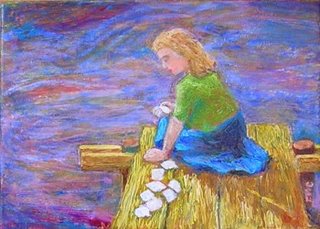

I picked up the idea for this technique at http://www.brigidmarlin.com/Pages/Mische.html
but fudged considerably; playing with eggs sounded too messy and I didn't get around to sanding, probably haven't been getting the layers thin enough or even enough. Doing it wrong like this makes for nice effects--though looking around her site makes for an embarrassing comparison. Maybe sometime next life...
I used casein & oils on 5X7 canvas, with a no-hair brush (alligator clip on a disposable chopstick, holding a thin sliver from a stiff rubber pipe.)
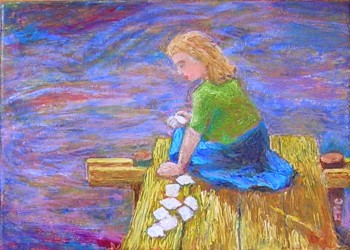

I picked up the idea for this technique at http://www.brigidmarlin.com/Pages/Mische.html
but fudged considerably; playing with eggs sounded too messy and I didn't get around to sanding, probably haven't been getting the layers thin enough or even enough. Doing it wrong like this makes for nice effects--though looking around her site makes for an embarrassing comparison. Maybe sometime next life...
I used casein & oils on 5X7 canvas, with a no-hair brush (alligator clip on a disposable chopstick, holding a thin sliver from a stiff rubber pipe.)
Old Poem May Say It Better
Something I wrote for a rather sweet little woman shortly before I met Anne. (I write fewer poems when I'm happy.)
TV GUIDE
Here, my sweet, is a magic
chemical to give you
historical perspective,
a certain glossy distance
between you and the news.
Sometimes it makes you laugh
to see the clowns in their
robes of shoddy royalty
doing the verbal tap-dance around
and around and around.
Sometimes you see high drama,
something to give you chills
about somebody telling the truth
who hasn't been shot yet.
Sometimes it gives you panic
terror to be at the mercy
of armed madmen, and fools
playing like drunken gods
for gold stars and party hats
and our lives.
Let me caress your nipples
gently, a touch that resonates
deep into your body. Close your eyes.
Ignore the strident ravings
distracting you from my body
and hold me; hold me.
Forrest Curo
maybe 1982(?)
TV GUIDE
Here, my sweet, is a magic
chemical to give you
historical perspective,
a certain glossy distance
between you and the news.
Sometimes it makes you laugh
to see the clowns in their
robes of shoddy royalty
doing the verbal tap-dance around
and around and around.
Sometimes you see high drama,
something to give you chills
about somebody telling the truth
who hasn't been shot yet.
Sometimes it gives you panic
terror to be at the mercy
of armed madmen, and fools
playing like drunken gods
for gold stars and party hats
and our lives.
Let me caress your nipples
gently, a touch that resonates
deep into your body. Close your eyes.
Ignore the strident ravings
distracting you from my body
and hold me; hold me.
Forrest Curo
maybe 1982(?)
Saturday, January 20, 2007
Nuff of All That
I'm tired of old Saddam just hanging around here. What's that boy in the White House been up to since then? I think I might just die of boredom before he kills us all. But it wouldn't make me happier if we hung him too, and the gang he rode in with. Better I should go to the zoo and watch monkeys.
Blessed are the fools, for we grow hardened to embarrassment and feel free to blather out truth.
In the Main Ring of this circus, we have the monkey show. Some people look on uncomprehendingly as the monkeys cleverly pick pockets and rip out throats; others wonder if they should be worried; are these critters going to get loose and do us harm out here in the audience? It's all just fuss.
Yes, the Wrath is loosed on our world; the fact that we can take this show seriously is just more evidence of our condition. "Pay no attention to Caesar; Caesar doesn't have the faintest notion what's really going on" says Bokonon, Kurt Vonnegut's holy false prophet in the jungle. Who calls himself a liar, but got that one right.
We are organs of God's pleasure, folks. (Quakers might rather think of ourselves as God's work-callused hands, but trying too hard just makes us twitch. And some people consider themselves born to lie about and be caressed, but that's not the sort of organs we are...) Martin Buber quotes the Hassidim about a man who keeps all the commandments, but has no yearning... He is admitted to Paradise, but doesn't care much for that, either. After awhile he says something like "Paradise, so what?" and they kick him out. I say that's not a punishment, but a mercy. Now he can yearn for Paradise.
Each of us is God telling himself a story. Let's make that a story about waking up and looking truth in the face. (If you think you can't face it, you're just scaring yourself with somebody's false notions.) The real truth is God. It's bewildering; it can be overwhelming (if you like) but there's more of this truth in a quiet voice than in a nuclear bomb. We've had enough horror flicks on this planet.
We don't have to be a hero; we don't have to save the planet; we just have to look truth in the face. It'll tell us what comes next...
Blessed are the fools, for we grow hardened to embarrassment and feel free to blather out truth.
In the Main Ring of this circus, we have the monkey show. Some people look on uncomprehendingly as the monkeys cleverly pick pockets and rip out throats; others wonder if they should be worried; are these critters going to get loose and do us harm out here in the audience? It's all just fuss.
Yes, the Wrath is loosed on our world; the fact that we can take this show seriously is just more evidence of our condition. "Pay no attention to Caesar; Caesar doesn't have the faintest notion what's really going on" says Bokonon, Kurt Vonnegut's holy false prophet in the jungle. Who calls himself a liar, but got that one right.
We are organs of God's pleasure, folks. (Quakers might rather think of ourselves as God's work-callused hands, but trying too hard just makes us twitch. And some people consider themselves born to lie about and be caressed, but that's not the sort of organs we are...) Martin Buber quotes the Hassidim about a man who keeps all the commandments, but has no yearning... He is admitted to Paradise, but doesn't care much for that, either. After awhile he says something like "Paradise, so what?" and they kick him out. I say that's not a punishment, but a mercy. Now he can yearn for Paradise.
Each of us is God telling himself a story. Let's make that a story about waking up and looking truth in the face. (If you think you can't face it, you're just scaring yourself with somebody's false notions.) The real truth is God. It's bewildering; it can be overwhelming (if you like) but there's more of this truth in a quiet voice than in a nuclear bomb. We've had enough horror flicks on this planet.
We don't have to be a hero; we don't have to save the planet; we just have to look truth in the face. It'll tell us what comes next...
Monday, January 01, 2007
For Saddam
Digusting
little man!
Strutting in a
djinn's palace on
a slippery heap,
proud
of ruthlessness,
cunning.
Photos with
American satraps--winks
and handshakes.
You were smarter
than them but
you never understood
your place.
Saddam, you married a
star-spangled
whore. Beware
the dagger in
your nuptual bed;
you should have known.
But you've had time,
since, to see
the other side
of atrocity.
Did you learn wisdom?
He should have given you
your knife fight:
some recognition of
your underlying
kinship
but he never will
and that's the most
significant difference
between you.
Forrest Curo, December 31 2006
little man!
Strutting in a
djinn's palace on
a slippery heap,
proud
of ruthlessness,
cunning.
Photos with
American satraps--winks
and handshakes.
You were smarter
than them but
you never understood
your place.
Saddam, you married a
star-spangled
whore. Beware
the dagger in
your nuptual bed;
you should have known.
But you've had time,
since, to see
the other side
of atrocity.
Did you learn wisdom?
He should have given you
your knife fight:
some recognition of
your underlying
kinship
but he never will
and that's the most
significant difference
between you.
Forrest Curo, December 31 2006
Saturday, November 04, 2006
finding God again through yoga and ineptitude
I've been very remiss about things lately, a prime example of what Paul said about doing everything but what we think we should. A dreadful example of it. David from Kwakerskripturestudy was wondering about me, not only because I wasn't commenting there but because I hadn't added anything here either.
Frankly, I'd hoped more people would read what I'd already posted here. But that ain't the way of it; we're writing for the birdcages (no matter how good our stuff is) just like when I published/edited Street Light (an interesting time, while it lasted.) Virtual birdcages, and where are the virtual birds to whitewash them?
Certainly part of this is that I really do love games, even Civilization. Which I think must be a bad influence; I wouldn't be surprised if GW plays it. Next time someone tells you about The Clash of Civilizations, nod wisely and remember this game. Where you meet all this great leaders from the past civilizations of the world, and all of them act like Cheney on speed. A loathsome crew, and how can one cope without being just as vile?
Luckily, virtual soldiers don't bleed. They don't come home in baskets or end up pushing shopping carts. You see them die, leaving nothing behind, but there'll be another just like them any time you reload the game.
We're different. We're manifestations of God. Even manifestations of God playing games while our projects languish and our wives complain that we're "playing That Stupid Game again!"
I haven't been altogether happy with myself.
What's wrong? I really do love to play games; get used to it! I don't want to wake up six months from now and realize that all I've done was to conquer the virtual Chinese and Spanish over and over and over, but I want to learn how this game works, even if it (fairly often) gets boring. Where else can I practice being a human being and see how it works, without harming myself or others? That is, after all, how we're designed to learn, by practice. I'm not sure that learning to be Attila the Hun is the best thing; go teaches better lessons (try dragongoserver.net!) My go teacher once said, "Improve your character and you'll improve your game 100%", and by now I know exactly what he meant. (Alas!)
I've made some progress on my yoga, not enough because the world keeps impinging, and because I've gotten old and stiff between the ears as well as in my back. I'm having to learn to give up progress, and thus I make progress, all the same. Because the point is to use the postures you can't do anymore, that you've done wrong and neglected and half-forgotten, as prayers for guidance, into what you can do that'll be best for body and mind.
Not getting myself sucked into an Officially Christian Quaker mailing list. I'd enjoyed some back-&-forth with a woman on Quaker-L, who suggested I join, but when I did, I found myself confronted by a demand that I not bother their simple minds unless I agreed to their statement about Jesus' place in our lives. I wasn't even sure what they meant by it, let alone what I would mean if I said it. So I thought about removing myself, and didn't, and six months later, when the Amish were being talked about both there and on the La Jolla Meeting list, I got confused and responded to a post from the wrong list. Oh well, here I am in the midst of them! Pretty soon, I'm defending the Hindu, and the moderator isn't objecting. (I may have had a couple posts dumped; they were either posted or rejected when my server was down the other day.) But I am definitely finding myself Anathema!
That's not good. It doesn't leave one eager to write more. One could be attacked!--One must be careful, not to be misunderstood.
What has been good about it... One person engaged another in an unpleasant, proof-text-quoting attack over his idea of "following Jesus" vs the attacker's notion that Jesus' role was to gain us forgiveness of our sins by sacrificing his life, after which we need do nothing so strenuous (and indeed had better not!)
All this traditional--and utterly senseless--Stuff helped put things back in perspective, gave me something to write about. Only Jesus could save me from this nonsense! There's this Sermon on the Mount, early in Matthew, where he talks about God, how he loves us like a (good) Father, doesn't wish us any harm, does good to us whether we've been bad or good. That makes sense.
We need to believe Jesus here--because it's the truth, and if we don't believe it, we won't know it, and we could get in trouble. People do. They get inflated ideas of their own importance, and of all the silly things they've learned, and it's not that God punishes them--but they do really terrible things to self and others, in this game. They'd be endlessly suffering, stuck in it eternally, if they didn't see through it sooner or later.
Once, having neglected my yoga for too long, I determined to make up for it by a strenuous effort. I'd forced myself into that posture where you lie down between your own heels... and I couldn't get out of it. I panicked, and jerked myself upright, and something went "TWANG!!!" in my lower back. I literally dragged myself onto the living room couch, where I spent the night wondering if I would ever walk again. (But I had the most wonderful feeling of energy lighting up everything from my butt to my brain!) The next day I needed crutches to interview someone for the paper.
I needed to trust God. I needed to pay attention to how things were in that particular moment--not how I wanted to be, but how I was--and accept that, let God show me the right way to work with it. I would have missed an interesting night on the couch, of course.
Frankly, I'd hoped more people would read what I'd already posted here. But that ain't the way of it; we're writing for the birdcages (no matter how good our stuff is) just like when I published/edited Street Light (an interesting time, while it lasted.) Virtual birdcages, and where are the virtual birds to whitewash them?
Certainly part of this is that I really do love games, even Civilization. Which I think must be a bad influence; I wouldn't be surprised if GW plays it. Next time someone tells you about The Clash of Civilizations, nod wisely and remember this game. Where you meet all this great leaders from the past civilizations of the world, and all of them act like Cheney on speed. A loathsome crew, and how can one cope without being just as vile?
Luckily, virtual soldiers don't bleed. They don't come home in baskets or end up pushing shopping carts. You see them die, leaving nothing behind, but there'll be another just like them any time you reload the game.
We're different. We're manifestations of God. Even manifestations of God playing games while our projects languish and our wives complain that we're "playing That Stupid Game again!"
I haven't been altogether happy with myself.
What's wrong? I really do love to play games; get used to it! I don't want to wake up six months from now and realize that all I've done was to conquer the virtual Chinese and Spanish over and over and over, but I want to learn how this game works, even if it (fairly often) gets boring. Where else can I practice being a human being and see how it works, without harming myself or others? That is, after all, how we're designed to learn, by practice. I'm not sure that learning to be Attila the Hun is the best thing; go teaches better lessons (try dragongoserver.net!) My go teacher once said, "Improve your character and you'll improve your game 100%", and by now I know exactly what he meant. (Alas!)
I've made some progress on my yoga, not enough because the world keeps impinging, and because I've gotten old and stiff between the ears as well as in my back. I'm having to learn to give up progress, and thus I make progress, all the same. Because the point is to use the postures you can't do anymore, that you've done wrong and neglected and half-forgotten, as prayers for guidance, into what you can do that'll be best for body and mind.
Not getting myself sucked into an Officially Christian Quaker mailing list. I'd enjoyed some back-&-forth with a woman on Quaker-L, who suggested I join, but when I did, I found myself confronted by a demand that I not bother their simple minds unless I agreed to their statement about Jesus' place in our lives. I wasn't even sure what they meant by it, let alone what I would mean if I said it. So I thought about removing myself, and didn't, and six months later, when the Amish were being talked about both there and on the La Jolla Meeting list, I got confused and responded to a post from the wrong list. Oh well, here I am in the midst of them! Pretty soon, I'm defending the Hindu, and the moderator isn't objecting. (I may have had a couple posts dumped; they were either posted or rejected when my server was down the other day.) But I am definitely finding myself Anathema!
That's not good. It doesn't leave one eager to write more. One could be attacked!--One must be careful, not to be misunderstood.
What has been good about it... One person engaged another in an unpleasant, proof-text-quoting attack over his idea of "following Jesus" vs the attacker's notion that Jesus' role was to gain us forgiveness of our sins by sacrificing his life, after which we need do nothing so strenuous (and indeed had better not!)
All this traditional--and utterly senseless--Stuff helped put things back in perspective, gave me something to write about. Only Jesus could save me from this nonsense! There's this Sermon on the Mount, early in Matthew, where he talks about God, how he loves us like a (good) Father, doesn't wish us any harm, does good to us whether we've been bad or good. That makes sense.
We need to believe Jesus here--because it's the truth, and if we don't believe it, we won't know it, and we could get in trouble. People do. They get inflated ideas of their own importance, and of all the silly things they've learned, and it's not that God punishes them--but they do really terrible things to self and others, in this game. They'd be endlessly suffering, stuck in it eternally, if they didn't see through it sooner or later.
Once, having neglected my yoga for too long, I determined to make up for it by a strenuous effort. I'd forced myself into that posture where you lie down between your own heels... and I couldn't get out of it. I panicked, and jerked myself upright, and something went "TWANG!!!" in my lower back. I literally dragged myself onto the living room couch, where I spent the night wondering if I would ever walk again. (But I had the most wonderful feeling of energy lighting up everything from my butt to my brain!) The next day I needed crutches to interview someone for the paper.
I needed to trust God. I needed to pay attention to how things were in that particular moment--not how I wanted to be, but how I was--and accept that, let God show me the right way to work with it. I would have missed an interesting night on the couch, of course.
Thursday, September 21, 2006
The Way to Quaker Renewal Part I
When I began coming regularly to meeting, some 15 years ago, I'd been acquainted with Friends since high school. For a long time, I hadn't seen much point in worshiping with them, but suddenly I very much wanted to. They appeared to be natural allies for the activist task I'd been given, but primarily the Meeting offered a way to center myself in the Spirit that had led me to that work.
I soon saw that I was both a Friend and a stranger. The Quaker form of worship made sense; it also moved and enlightened me. I liked the people and found inspiration in the history; but these people were very far from their historical founders. In my small Meeting, there were few inclined to join in my activism, and none who agreed as to its urgency.
Why did Friends seem overwhelmingly old, white, financially comfortable, and effectively unconcerned with poor people's suffering? Why, if our tradition embodied Truth, as I felt it did-- Why was no one moved to share it with our neighbors caught up in the World's turmoil? How had the raging fire of the 17th Century become the cooling ashes of the 20th?
When I later came to Pendle Hill, I was curious about that, but I was still yearning to answer the operative question: How can Friends become the movement we were called to be, so many years ago?
Many Friends share this concern, and try a multitude of remedies: becoming more explicitly Christian, excavating early Quaker writings and customs, abjuring agenda-worship in our business meetings. Some of us seek truth in other traditions, while others complain of Friends losing our Truth in a stew of "consumer religion." It's all symptomatic of not knowing the cure, but wanting it desperately.
I considered Friends from another angle: too attached to sweetness and light, too adverse to intellectual strife. We are, I said, unable to attract converts like early Friends because we won't struggle for the agreement needed among ourselves before we can say what we believe and why anyone might care to join us. This made an interesting flawed pamphlet--which I circulated to Friends on the internet, but couldn't satisfactorily finish, finding myself too wishy-washy to want useless conflict in my own meeting.
The kind of conflict I'd envisioned between people who'd rather find new truth than confirm their prejudices is not what people generally do. And when we confront each other's ideology-- the set of beliefs supporting a way of life that someone doesn't want to change-- That is certainly not likely.
The conflict I'd most like Friends to address is the one between Comfortable Friends and "you Hair-shirt People." While it galls me to be caught in the middle of any road, I find people acquainted with the Spirit in both groups. But we all ascribe too much importance to physical and human factors, whether for good or for ill.
To face the situation squarely, we'd need to follow some of Paul's advice: "to offer your very selves to God: a living sacrifice, dedicated and fit for his acceptance, the worship offered by mind and heart. Adapt yourselves no longer to the patterns of this present world, but let your minds be remade and your whole nature thus transformed. Then you will be able to discern the will of God, and to know what is good, acceptable, and perfect."
So far as we have not let our minds be remade, we are unavoidably duped by the Powers of this world.
I soon saw that I was both a Friend and a stranger. The Quaker form of worship made sense; it also moved and enlightened me. I liked the people and found inspiration in the history; but these people were very far from their historical founders. In my small Meeting, there were few inclined to join in my activism, and none who agreed as to its urgency.
Why did Friends seem overwhelmingly old, white, financially comfortable, and effectively unconcerned with poor people's suffering? Why, if our tradition embodied Truth, as I felt it did-- Why was no one moved to share it with our neighbors caught up in the World's turmoil? How had the raging fire of the 17th Century become the cooling ashes of the 20th?
When I later came to Pendle Hill, I was curious about that, but I was still yearning to answer the operative question: How can Friends become the movement we were called to be, so many years ago?
Many Friends share this concern, and try a multitude of remedies: becoming more explicitly Christian, excavating early Quaker writings and customs, abjuring agenda-worship in our business meetings. Some of us seek truth in other traditions, while others complain of Friends losing our Truth in a stew of "consumer religion." It's all symptomatic of not knowing the cure, but wanting it desperately.
I considered Friends from another angle: too attached to sweetness and light, too adverse to intellectual strife. We are, I said, unable to attract converts like early Friends because we won't struggle for the agreement needed among ourselves before we can say what we believe and why anyone might care to join us. This made an interesting flawed pamphlet--which I circulated to Friends on the internet, but couldn't satisfactorily finish, finding myself too wishy-washy to want useless conflict in my own meeting.
The kind of conflict I'd envisioned between people who'd rather find new truth than confirm their prejudices is not what people generally do. And when we confront each other's ideology-- the set of beliefs supporting a way of life that someone doesn't want to change-- That is certainly not likely.
The conflict I'd most like Friends to address is the one between Comfortable Friends and "you Hair-shirt People." While it galls me to be caught in the middle of any road, I find people acquainted with the Spirit in both groups. But we all ascribe too much importance to physical and human factors, whether for good or for ill.
To face the situation squarely, we'd need to follow some of Paul's advice: "to offer your very selves to God: a living sacrifice, dedicated and fit for his acceptance, the worship offered by mind and heart. Adapt yourselves no longer to the patterns of this present world, but let your minds be remade and your whole nature thus transformed. Then you will be able to discern the will of God, and to know what is good, acceptable, and perfect."
So far as we have not let our minds be remade, we are unavoidably duped by the Powers of this world.
Quaker Renewal II : Powers and Principalities?
What kind of language is that? What does it mean, and should we care? It's poetic language, and it refers to things we don't comprehend easily via other ways of speaking. The author of Ephesians referred to struggling, "not against men, but against Principalities and Powers." [6:12] Christians for nearly 2000 years since then have found those words enlightening, including Walter Wink, a contemporary theologian and lifelong activist.
According to Wink: "We moderns cannot bring ourselves by any feat of will or imagination to believe in the real existence of these mythological entities that traditionally have been lumped under the general category "principalities and powers." But this statement begins a series of books for moderns, exploring that very concept. Because it fits too well with phenomena we encounter--not (he admits) as "invisible demonic beings flapping around in the sky, occasionally targeting some luckless mortal with their malignant payload of disease, lust, possession, or death"-- but in the entrenched background assumptions of people who rule and speak for us, the intractable perversities of institutional policy, the invisible blind spots in even our own well-considered opinions.[Naming the Powers pg 5 Fortress Press, 1984]
His predecessor William Stringfellow, a Harlem attorney active in the movements for civil rights and against the US/Vietnam war, also found use for this terminology. "There is nothing particularly mysterious, superstitious, or imaginary about principalities... The realities to which the biblical terms 'principalities and powers' refer are quite familiar to modern society, though they may be called by different names. What the Bible calls 'principalities and powers" are called in contemporary language 'ideologies,' 'institutions,' and 'images.'
"A principality, whatever its particular form and variety, is a living reality, distinguishable from human and other organic life. It is not made or instituted by men, but, as with men and all creation, made by God for his own pleasure." [Free in Obedience, Seabury Press 1964 pg 52]
Stringfellow gave examples. Marilyn Monroe, when he wrote, was a potent 'image.' Although she herself had recently died, "there were two lives that claimed and used that name, one a principality, the other a person... In fact, every person is accompanied in his life by an image; he is often controlled or destroyed by his image, and often it survives him." [pg 53]
Hitler was a less benign example: "It may well be that long before his actual suicide the person named Hitler had been altogether obliterated by the principality called Hitler; that the person had indeed been possessed by a demon of that name, and that the devastation and massacre wrought in the name of Hitler was not the work of just some dark genius of the man, nor even of the man's insanity or gross criminality, but of the awesome demonic power that possessed him." [pg 55]
Few of us have images of such power, but everyone's image enjoys a little worship, and so we must struggle against demands that we "give up [our] life as a person to the service and homage of the image." [55] Not only are Quakers not immune; Quaker traditions of dedication and service may well make us particularly susceptible!
"Institutions" need little explanation; we know many examples, some few of which may even be benign. But "in the end, the claim for service which an institution makes upon a man is an invitation to surrender his life in order that the institution be preserved and prosper. It is an invitation to bondage." [57] Of course this is perfectly customary and taken for granted, but it deserves more thought than it gets.
"Ideologies" include the obvious pejorative examples--Communism, fascism, racism and the like but also: "Humanism, capitalism, democracy, rationalism--though Americans think of these as benevolent powers." [57]
Stringfellow's categories naturally overlap, and can't cover all possible examples; "Sex, fashion, and sports are all among the angelic powers." So, particularly, is "money." [59]
"Like all men and all things, the angelic powers and principalities are fallen and become demonic powers. 'Demonic' does not mean evil; the word refers rather to death, to fallenness." [62]
Fallen? There's another unsettling word. Modern-day Quakers don't often call anything "fallen," or "demonic." Most modern Quakers probably don't believe in "The Fall".
A few hundred years ago, The Fall was a common bottom-line assumption. And now that we don't agree with it, we are quite sure there is no truth in the notion, certainly nothing important that we should have to wrestle with.
Isn't that change itself an example?--the tracks of a Power at work among us?
Here is a new, widely-shared, tenacious gestalt of attitude and belief: that only what we can see is real. It has made itself thoroughly at home, as if it had always been the norm. There is no particular evidence supporting it and yet it maintains itself in human minds, setting the context of what we will think and what we will attempt, not needing to "possess" anyone by force because it so seldom comes to our attention, let alone our suspicion.
The notion of The Fall was equally unquestioned. One reason for George Fox's continual trouble with the authorities was his belief that he had been freed from the domination of Sin within this bodily life-- something they considered a blasphemous impossibility. But Fox agreed with them that sin afflicted the bulk of humanity, not only in their inequities and cruelties but in what we would consider their harmless amusements. Barclay, writing for non-Quakers--but with no evident disagreement from Fox or others--says:
"All Adam's posterity (or mankind), both Jew and Gentiles, as to the first Adam, or earthly man, is fallen, degenerated, and dead, deprived of the sensation or feeling of this inward testimony or seed of God, and is subject unto the power, nature, and seed of the serpent, which he sows in men's hearts, while they abide in this natural and corrupted state, from whence it comes, that not their words and deeds only, but all their imaginations, are evil perpetually in the sight of God, as proceeding from this depraved and wicked seed." [Apology pg 11]
I'm not calling this an accurate model of human nature, or one we should return to. There was a serious flaw in it, or rather in this half of the overall concept: the notion that there could be a human nature separate from God. Our connectedness to God was then tacked on, in the form of "Christ, who enlightens every man who comes into the world"--to explain the presence of everything good in us.
Unfortunately, this description still consigned "our own will" to the "natural and corrupted" side of things. "Quietism", the belief that we can best serve God by annihilation of everything "creaturely" about us, was consequently widespread among Friends for over a hundred years.
Fenelon, a Catholic mystic of the time, was an influential example of such thinking. Although his letters reveal him as a wise, gently humorous and compassionate spiritual adviser, his theology was bound by the same harsh judgment of all things merely human: "Let [God] do as He sees fit with you. Be content to obey His will in all things, and to merge your will concerning everything in His. What right have you, who are not your own, to any intrinsic possession? A slave has no proprietary rights, how much less the creature which in itself is mere sin and nothingness, and which can possess nought save by the gift of God?" [The Royal Way of the Cross,tr H. Sidney Lear, 1980, The Community of Jesus, Inc. Orleans, MA 02633 pg 160]
John Woolman was no less a Quietist: "In true silence strength is renewed, and the mind is weaned from all things save as they may be enjoyed in the divine will; and a lowliness in outward living, opposite to worldly honour, becomes truly acceptable to us. In the desire after outward gain, the mind is prevented from a perfect attention to the voice of Christ; yet being weaned from all things, except as they may be enjoyed in the divine will, the pure light shines into the soul. Where the fruits of the spirit which is of this world are brought forth by many who profess to be led by the Spirit of truth, and cloudiness is felt to be gathering over the visible Church, the sincere in heart, who abide in true stillness, and are exercised therein before the Lord for His name's sake, have knowledge of Christ in the fellowship of His sufferings; and inward thankfulness is felt at times, that through Divine love our own wisdom is cast out, and that forward, active part in us is subjected, which would rise and do something without the pure leadings of the spirit of Christ."
In the midst of a highly-effective campaign for an issue that intensely concerned him--persuading American Friends to free their slaves--he says: "I was deeply engaged in inward cries to the Lord for help, that I might stand wholly resigned, and move only as He might be pleased to lead me."
Later, in a time of sickness, he "heard a soft melodious voice, more pure and harmonious than any I had heard with my ears before; I believed it was the voice of an angel who spake to the other angels; the words were, 'John Woolman is dead.' " When he thought about it, he gratefully concluded that the words "meant no more than the death of my own will."
Is our "own will" necessarily opposed to God's? We have all experienced collisions between God's will and our own-- and would prefer this to happen less often-- but how could anything in this creation be entirely separate from God?
There is merit in the Quietist program to avoid being enslaved to our capricious personal wants and errors, but not in the assumptions used to justify it.
Some sayings attributed to Jesus could suggest an ethic of self-annihilation, but they aren't consistent with the teaching that God is our loving Father. Would God crush the wills he gave us?-- or would he guide those wills toward wanting our true good? These quotes, I think, were misinterpreted in a spirit better suited to earlier times--not the Spirit of Modernism that so befuddles modern Americans, but a different Power, pretending to absolute truth and unlimited authority as these things characteristically do.
Aren't I arbitrarily adopting one notion from the Christian tradition--the Powers--and dismissing a related notion, The Fall? No, I find some truth in both, and want to bring that truth into this present milieu, so different and so much like the one where they developed.
I say that a bible such as the Hebrew Scriptures, the Christian Bible, or the Koran--is itself a principality of great power, whether for good and for misuse. (Consider how Romans 13: "Be subject to the governing authorities"--was once used by German churches to blind and paralyze themselves in the face of the Nazi regime.) Such things are not given to render us foolproof or to ossify our prejudices, but rather to help us find truths we might otherwise miss in the routine course of our lives.
According to Wink: "We moderns cannot bring ourselves by any feat of will or imagination to believe in the real existence of these mythological entities that traditionally have been lumped under the general category "principalities and powers." But this statement begins a series of books for moderns, exploring that very concept. Because it fits too well with phenomena we encounter--not (he admits) as "invisible demonic beings flapping around in the sky, occasionally targeting some luckless mortal with their malignant payload of disease, lust, possession, or death"-- but in the entrenched background assumptions of people who rule and speak for us, the intractable perversities of institutional policy, the invisible blind spots in even our own well-considered opinions.[Naming the Powers pg 5 Fortress Press, 1984]
His predecessor William Stringfellow, a Harlem attorney active in the movements for civil rights and against the US/Vietnam war, also found use for this terminology. "There is nothing particularly mysterious, superstitious, or imaginary about principalities... The realities to which the biblical terms 'principalities and powers' refer are quite familiar to modern society, though they may be called by different names. What the Bible calls 'principalities and powers" are called in contemporary language 'ideologies,' 'institutions,' and 'images.'
"A principality, whatever its particular form and variety, is a living reality, distinguishable from human and other organic life. It is not made or instituted by men, but, as with men and all creation, made by God for his own pleasure." [Free in Obedience, Seabury Press 1964 pg 52]
Stringfellow gave examples. Marilyn Monroe, when he wrote, was a potent 'image.' Although she herself had recently died, "there were two lives that claimed and used that name, one a principality, the other a person... In fact, every person is accompanied in his life by an image; he is often controlled or destroyed by his image, and often it survives him." [pg 53]
Hitler was a less benign example: "It may well be that long before his actual suicide the person named Hitler had been altogether obliterated by the principality called Hitler; that the person had indeed been possessed by a demon of that name, and that the devastation and massacre wrought in the name of Hitler was not the work of just some dark genius of the man, nor even of the man's insanity or gross criminality, but of the awesome demonic power that possessed him." [pg 55]
Few of us have images of such power, but everyone's image enjoys a little worship, and so we must struggle against demands that we "give up [our] life as a person to the service and homage of the image." [55] Not only are Quakers not immune; Quaker traditions of dedication and service may well make us particularly susceptible!
"Institutions" need little explanation; we know many examples, some few of which may even be benign. But "in the end, the claim for service which an institution makes upon a man is an invitation to surrender his life in order that the institution be preserved and prosper. It is an invitation to bondage." [57] Of course this is perfectly customary and taken for granted, but it deserves more thought than it gets.
"Ideologies" include the obvious pejorative examples--Communism, fascism, racism and the like but also: "Humanism, capitalism, democracy, rationalism--though Americans think of these as benevolent powers." [57]
Stringfellow's categories naturally overlap, and can't cover all possible examples; "Sex, fashion, and sports are all among the angelic powers." So, particularly, is "money." [59]
"Like all men and all things, the angelic powers and principalities are fallen and become demonic powers. 'Demonic' does not mean evil; the word refers rather to death, to fallenness." [62]
Fallen? There's another unsettling word. Modern-day Quakers don't often call anything "fallen," or "demonic." Most modern Quakers probably don't believe in "The Fall".
A few hundred years ago, The Fall was a common bottom-line assumption. And now that we don't agree with it, we are quite sure there is no truth in the notion, certainly nothing important that we should have to wrestle with.
Isn't that change itself an example?--the tracks of a Power at work among us?
Here is a new, widely-shared, tenacious gestalt of attitude and belief: that only what we can see is real. It has made itself thoroughly at home, as if it had always been the norm. There is no particular evidence supporting it and yet it maintains itself in human minds, setting the context of what we will think and what we will attempt, not needing to "possess" anyone by force because it so seldom comes to our attention, let alone our suspicion.
The notion of The Fall was equally unquestioned. One reason for George Fox's continual trouble with the authorities was his belief that he had been freed from the domination of Sin within this bodily life-- something they considered a blasphemous impossibility. But Fox agreed with them that sin afflicted the bulk of humanity, not only in their inequities and cruelties but in what we would consider their harmless amusements. Barclay, writing for non-Quakers--but with no evident disagreement from Fox or others--says:
"All Adam's posterity (or mankind), both Jew and Gentiles, as to the first Adam, or earthly man, is fallen, degenerated, and dead, deprived of the sensation or feeling of this inward testimony or seed of God, and is subject unto the power, nature, and seed of the serpent, which he sows in men's hearts, while they abide in this natural and corrupted state, from whence it comes, that not their words and deeds only, but all their imaginations, are evil perpetually in the sight of God, as proceeding from this depraved and wicked seed." [Apology pg 11]
I'm not calling this an accurate model of human nature, or one we should return to. There was a serious flaw in it, or rather in this half of the overall concept: the notion that there could be a human nature separate from God. Our connectedness to God was then tacked on, in the form of "Christ, who enlightens every man who comes into the world"--to explain the presence of everything good in us.
Unfortunately, this description still consigned "our own will" to the "natural and corrupted" side of things. "Quietism", the belief that we can best serve God by annihilation of everything "creaturely" about us, was consequently widespread among Friends for over a hundred years.
Fenelon, a Catholic mystic of the time, was an influential example of such thinking. Although his letters reveal him as a wise, gently humorous and compassionate spiritual adviser, his theology was bound by the same harsh judgment of all things merely human: "Let [God] do as He sees fit with you. Be content to obey His will in all things, and to merge your will concerning everything in His. What right have you, who are not your own, to any intrinsic possession? A slave has no proprietary rights, how much less the creature which in itself is mere sin and nothingness, and which can possess nought save by the gift of God?" [The Royal Way of the Cross,tr H. Sidney Lear, 1980, The Community of Jesus, Inc. Orleans, MA 02633 pg 160]
John Woolman was no less a Quietist: "In true silence strength is renewed, and the mind is weaned from all things save as they may be enjoyed in the divine will; and a lowliness in outward living, opposite to worldly honour, becomes truly acceptable to us. In the desire after outward gain, the mind is prevented from a perfect attention to the voice of Christ; yet being weaned from all things, except as they may be enjoyed in the divine will, the pure light shines into the soul. Where the fruits of the spirit which is of this world are brought forth by many who profess to be led by the Spirit of truth, and cloudiness is felt to be gathering over the visible Church, the sincere in heart, who abide in true stillness, and are exercised therein before the Lord for His name's sake, have knowledge of Christ in the fellowship of His sufferings; and inward thankfulness is felt at times, that through Divine love our own wisdom is cast out, and that forward, active part in us is subjected, which would rise and do something without the pure leadings of the spirit of Christ."
In the midst of a highly-effective campaign for an issue that intensely concerned him--persuading American Friends to free their slaves--he says: "I was deeply engaged in inward cries to the Lord for help, that I might stand wholly resigned, and move only as He might be pleased to lead me."
Later, in a time of sickness, he "heard a soft melodious voice, more pure and harmonious than any I had heard with my ears before; I believed it was the voice of an angel who spake to the other angels; the words were, 'John Woolman is dead.' " When he thought about it, he gratefully concluded that the words "meant no more than the death of my own will."
Is our "own will" necessarily opposed to God's? We have all experienced collisions between God's will and our own-- and would prefer this to happen less often-- but how could anything in this creation be entirely separate from God?
There is merit in the Quietist program to avoid being enslaved to our capricious personal wants and errors, but not in the assumptions used to justify it.
Some sayings attributed to Jesus could suggest an ethic of self-annihilation, but they aren't consistent with the teaching that God is our loving Father. Would God crush the wills he gave us?-- or would he guide those wills toward wanting our true good? These quotes, I think, were misinterpreted in a spirit better suited to earlier times--not the Spirit of Modernism that so befuddles modern Americans, but a different Power, pretending to absolute truth and unlimited authority as these things characteristically do.
Aren't I arbitrarily adopting one notion from the Christian tradition--the Powers--and dismissing a related notion, The Fall? No, I find some truth in both, and want to bring that truth into this present milieu, so different and so much like the one where they developed.
I say that a bible such as the Hebrew Scriptures, the Christian Bible, or the Koran--is itself a principality of great power, whether for good and for misuse. (Consider how Romans 13: "Be subject to the governing authorities"--was once used by German churches to blind and paralyze themselves in the face of the Nazi regime.) Such things are not given to render us foolproof or to ossify our prejudices, but rather to help us find truths we might otherwise miss in the routine course of our lives.
Quaker Renewal Part III: The Truth of "The Fall"
So what is the truth, in calling ourselves and our world "fallen"?
First of all, none of us ever becomes that ideal person we once thought we were, and might still want to be. All our efforts in that direction collide with what we will want at other moments.
If we make our ideal more "flexible," make "giving ourselves some slack" a source of self-satisfaction, strive for "balance"--we can only teeter.
We can not simply be, like Adam--perfectly unconcerned with whether he might be developing "fruit addiction," or whether he "should be eating more fruit"--or whether that fruit over there on that tree God said he should stay away from would agree with him, or not.
He could not even wonder, was it wrong of him to wonder what it tasted like? Would it be wrong to disobey God? What did "wrong" mean? He was not even capable of criminal intent! As God points out, "I am not punishing Adam and his descendants for the act, but... rather the fruit in question is poisonous in its own right and its effects, unfortunately, last countless generations." [Smullyan, "Is God a Taoist" from The Tao is Silent ,1977, also available in The Mind's I, Douglas Hofstadter & Daniel C. Dennett,1981]
So what was that poisonous tree--that attractive nuisance--doing in the nursery with God's hapless children? Who let the snake loose in there, unsupervised? Whatever this story means, we can't say it caught God by surprise. We might not like the outcome, but it must have been somehow necessary.
In some interpretations, the snake really gave us wisdom. "The Knowledge of Good and Evil." Some wisdom. Adam looked at the perfect body God had made for him, and "saw that he was naked."
Clothing taboos and fashions, they vary with the climate and the age. Guilt doesn't. Adam's body had been nude from the moment he was created; what he wanted to hide was his self, his ego. Adam's soul was showing; he was afraid to let God see or to look at it himself, and he didn't have a thing to put over it--no new accomplishment to brag about, nothing to say, not a thought or a pain or a story to tell, just juice on his chin and a real bad feeling in his stomach.
He said, "The woman You gave me made me do it." She in turn pointed to the snake. The snake just sat there, saying nothing. We should be so wise.
People can take this sort of fiction, work out "the" meaning, and think they've got the whole nourishment of it. Not so, that chewy fictional husk provides fiber and gravel for the digestive process. The wisdom of ancient people went into their stories as simply and naturally as their scientific and historic misconceptions. If there were only one meaning--like "Original Sin," for example, or "Don't blame others!"--we could dispense with the story, as people lately have been inclined to do.
We were given this story--and not a self-help book, or a theological treatise--because what is meant by "The Fall" is all-pervasive, too complex and too simple to figure out. But it is not a fictional condition.
We can live, mentally, in a no-fault, harm-reduction universe. But not naturally. Coercion, punishment and deterrents are the way of our world. Practices based on such concepts masquerade as "justice," but seldom touch the greatest wrongs, nor ever run out of petty criminals to torment.
The Fall is both personal and collective. You are blessed, if you've never treated anyone unforgivably. You may think you haven't, and then wake up remembering, in the middle of some very long night. God has forgiven you; even the person you wronged has forgiven, but she still remembers and so do you.
Maybe you've avoided that sort of affliction. There are still those myriad institutional wrongs, and while you may have worked against them, in every way you knew, on every occasion that presented itself--They still go on; and you can't even buy a loaf of bread without contributing, in some measure, to their perpetration.
There are two basic elements attributed to this "curse." They constitute the basic conditions of human life, in the world we know. We cause, and undergo, suffering and guilt. And we die.
Death, too, can be considered as a principality. In Stringfellow's schema, remember, death is the ruling power of this world, "greater, apart from God himself, than any other reality in existence."[Free, page 69] "...In the epoch of the Fall, as the Bible designates this scene-every value, every goal, every policy, every action, every routine, every enterprise of each and every principality has the elemental significance of death, notwithstanding any contrary appearances. This is eminently so with respect to nations, for nations are, as Revelation indicates, the archetypical principalities. All other assorted, diverse principalities resemble them, imitate them, and substitute for them.
"All virtues which nations elevate and idolize--military prowess, material abundance, technological sophistication, imperial grandeur, high culture, racial pride, trade, prosperity, conquest, sport, language or whatever--are ancillary and subservient to the moral presence of death in the nation. And it is the same with the surrogate nations--the other principalities, like the corporations and conglomerates, ideologies and bureaucracies, and authorities and institutions of every name and description." [Stringfellow, _An Ethic for Christians & Other Aliens in a Strange Land_, 1973, Word Incorporated, pg 67]
Obviously, to make war is to pay tribute to death. Whether or not we would put it in those terms, Quakers and increasingly many others recognize war as a great evil, and work to stop each war we find our nation pursuing. But all these wars are symptomatic of "death incarnate in society, and not the other way around... The notion has been widespread that the death-purpose evident in the war could somehow be undone if the war could be ended. But that is as false as it is naive; this Indochina war did not sponsor the power of death in American society. The war rather expresses, grotesquely, the moral presence of death which has always been in America, as in other principalities. And the end of the war promises no end, no diminishment even, to that presence."[Ethic pg 70]
That lingering 'presence of death' is far more than our habitual national faith in American military power. "With these creatures, as with human beings, it is never quite possible to express either the whole personality or the multiple attributes and abilities of a principality in a name, much less that of the legion of principalities and powers. The biblical practice of invoking many names or of interchanging various names, when speaking of principalities, is a help in grasping the many-faceted character and versatility of these powers. After all, what is being described and designated is a form of life, a creatureliness, which is potent and mobile and diverse, not static or neat or simply defined by what it may now or then be called. So such names as are used for the principalities, either in the biblical witness or in common talk, are necessarily suggestive, intuitive, emphatic." [pg 79]
Thus what Stringfellow calls 'the presence of death' is involved in such seemingly unrelated, universal human preoccupations as personal wealth, social roles, occupations and positions, everything that might conceivably provide material for an obituary. In practice, we've generally been taught: "Seek first your own material and empirical welfare and you will think you are justified in your existence." That if you "make work your monument, make it the reason for your life, ... you will survive your death in some way, until the monument itself is discarded or crumbles in some other way."[Stringfellow, _Instead of Death_, Seabury Press 1963, page 39] And so our familar American success-worship is intrinsically tied to fears for our survival, especially against the forms of social death: low-wage work, unemployment, homelessness and the various forms of madness that feed on personal failure.
This unexpected connection comes directly from the tale of Eden. Harsh labor and death are the specific consequences of the Fall : "Cursed is the ground because of you; in toil you shall eat of it all the days of your life; thorns and thistles it shall bring forth to you, and you shall eat the plants of the field. In the sweat of your face you shall eat bread till you return to the ground, for out of it you were taken; you are dust, and to dust you shall return."
"The fallenness of work, the broken relationship between men and the rest of creation which work is, involves both the alienation of men from nature and from the rest of creation, including the principalities and powers. In work men lose their dominion over the principalities and are in bondage to the principalities. Instead of men ruling the great institutions--corporations, unions, and so on--men are ruled by the great institutions. And the claim over a man's life that all principalities make is idolatrous, that is, the claim that the significance and destiny of a man depends upon his service to the survival and preservation of the principality." [ page 42] It is no better to be relegated to "prolonged, enforced idleness," as happens to many in our country. And of course, leisure devoted to filling time is "as much an anticipation of death, as much an enslavement to the world, as work is... The burden of work, which is the threat of death, is neither mitigated nor overcome in the choice of work, in the product of work, in the reward for work, in non-work, in the moral vanity of work." [pg 43-44]
The way out, from this seemingly inescapable futility, is through Christ. "The work of God in Christ is God making the world for Himself." [pg 45]
If your experience of the word 'Christ' has been as a stick sanctimonious people have tried to beat you with, this kind of talk may well make you itch. And what, you might ask, does it mean to be "in" Christ? We are offered an exit, but it's not at all clear, how that door opens.
Furthermore, we have arrived at another false dichotomy. Earlier we brought up the traditional notion of an isolated Bad Self, which could only be fixed by Christ aka everything good in us. Now we're talking about an entirely-fallen world, oppressed by the Powers, which can only be fixed by Christ, aka the work of God toward healing its fallen condition.
But there is one world, not two, and only one God at work throughout.
Before the Fall, remember, God looked at what he had made, and saw that it was good. "The Powers are also no less the good creations of a good God than we are, and they are no more fallen than we." [Unmasking the Powers, Walter Wink, 1986, Fortress Press, pg 96] The world is a better place--at the very least, a more interesting one--for the existence of its manifold variety of beings. If tigers, mountains and storms are beautiful, and also can kill us, so it is with powers or principalities. "Angel", after all, is a word for this same kind of entity. And so is "demon," although early Christians made it a word exclusively for evil spirits. But to their contemporary Jews, these "gods" had been merely various "angels" of other nations, and even the Christians came to acknowledge the "daemon" of Socrates as something basically good.
What makes people describe these entities as 'in rebellion against God' is their demand to be worshiped. This demand is not a simple matter of enjoying little rituals of appreciation, or the sacrifice of an occasional child (What else do people sacrifice their children to, anyway, but to some power conceived-of as "their own good"?) It is the powers' perverse appetite--for the "respect, honor, and devotion" appropriate to their creator--that throws them into discord.
But why have these "good creations of a good God" become rebellious and hostile toward us?
We can speak of the principalities as 'living' beings, because they act as if they had "a will of their own," tenaciously resisting human efforts to bring them under our control. But they are said to be subject to the Rumpelstiltskin Effect: if we can name them correctly, we can at least resist being enslaved by them.
Mis-naming has a different kind of power. The child who is told he is "a bad boy" too effectively may never manage to be altogether "good." Misnaming confuses our speech. For an individual, it can impair the ability to identify worthwhile goals or to strive for them effectively. Within a group of people, it must distort communications and disconnect their conscious intentions from whatever effects will actually ensue. To misname a principality--a fluid and half-metaphorical creature by its very nature--must fragment it into a mist of images, all of them trying to pass under the same false i.d. (What, for example, has happened to words like "love"? "Freedom"? "Faith"? If someone were to glimpse the reality behind a label like "Christ"--How could she convey it to people who think "Jesus" just means George Bush's imaginary friend, who tells him to start wars?)
First of all, none of us ever becomes that ideal person we once thought we were, and might still want to be. All our efforts in that direction collide with what we will want at other moments.
If we make our ideal more "flexible," make "giving ourselves some slack" a source of self-satisfaction, strive for "balance"--we can only teeter.
We can not simply be, like Adam--perfectly unconcerned with whether he might be developing "fruit addiction," or whether he "should be eating more fruit"--or whether that fruit over there on that tree God said he should stay away from would agree with him, or not.
He could not even wonder, was it wrong of him to wonder what it tasted like? Would it be wrong to disobey God? What did "wrong" mean? He was not even capable of criminal intent! As God points out, "I am not punishing Adam and his descendants for the act, but... rather the fruit in question is poisonous in its own right and its effects, unfortunately, last countless generations." [Smullyan, "Is God a Taoist" from The Tao is Silent ,1977, also available in The Mind's I, Douglas Hofstadter & Daniel C. Dennett,1981]
So what was that poisonous tree--that attractive nuisance--doing in the nursery with God's hapless children? Who let the snake loose in there, unsupervised? Whatever this story means, we can't say it caught God by surprise. We might not like the outcome, but it must have been somehow necessary.
In some interpretations, the snake really gave us wisdom. "The Knowledge of Good and Evil." Some wisdom. Adam looked at the perfect body God had made for him, and "saw that he was naked."
Clothing taboos and fashions, they vary with the climate and the age. Guilt doesn't. Adam's body had been nude from the moment he was created; what he wanted to hide was his self, his ego. Adam's soul was showing; he was afraid to let God see or to look at it himself, and he didn't have a thing to put over it--no new accomplishment to brag about, nothing to say, not a thought or a pain or a story to tell, just juice on his chin and a real bad feeling in his stomach.
He said, "The woman You gave me made me do it." She in turn pointed to the snake. The snake just sat there, saying nothing. We should be so wise.
People can take this sort of fiction, work out "the" meaning, and think they've got the whole nourishment of it. Not so, that chewy fictional husk provides fiber and gravel for the digestive process. The wisdom of ancient people went into their stories as simply and naturally as their scientific and historic misconceptions. If there were only one meaning--like "Original Sin," for example, or "Don't blame others!"--we could dispense with the story, as people lately have been inclined to do.
We were given this story--and not a self-help book, or a theological treatise--because what is meant by "The Fall" is all-pervasive, too complex and too simple to figure out. But it is not a fictional condition.
We can live, mentally, in a no-fault, harm-reduction universe. But not naturally. Coercion, punishment and deterrents are the way of our world. Practices based on such concepts masquerade as "justice," but seldom touch the greatest wrongs, nor ever run out of petty criminals to torment.
The Fall is both personal and collective. You are blessed, if you've never treated anyone unforgivably. You may think you haven't, and then wake up remembering, in the middle of some very long night. God has forgiven you; even the person you wronged has forgiven, but she still remembers and so do you.
Maybe you've avoided that sort of affliction. There are still those myriad institutional wrongs, and while you may have worked against them, in every way you knew, on every occasion that presented itself--They still go on; and you can't even buy a loaf of bread without contributing, in some measure, to their perpetration.
There are two basic elements attributed to this "curse." They constitute the basic conditions of human life, in the world we know. We cause, and undergo, suffering and guilt. And we die.
Death, too, can be considered as a principality. In Stringfellow's schema, remember, death is the ruling power of this world, "greater, apart from God himself, than any other reality in existence."[Free, page 69] "...In the epoch of the Fall, as the Bible designates this scene-every value, every goal, every policy, every action, every routine, every enterprise of each and every principality has the elemental significance of death, notwithstanding any contrary appearances. This is eminently so with respect to nations, for nations are, as Revelation indicates, the archetypical principalities. All other assorted, diverse principalities resemble them, imitate them, and substitute for them.
"All virtues which nations elevate and idolize--military prowess, material abundance, technological sophistication, imperial grandeur, high culture, racial pride, trade, prosperity, conquest, sport, language or whatever--are ancillary and subservient to the moral presence of death in the nation. And it is the same with the surrogate nations--the other principalities, like the corporations and conglomerates, ideologies and bureaucracies, and authorities and institutions of every name and description." [Stringfellow, _An Ethic for Christians & Other Aliens in a Strange Land_, 1973, Word Incorporated, pg 67]
Obviously, to make war is to pay tribute to death. Whether or not we would put it in those terms, Quakers and increasingly many others recognize war as a great evil, and work to stop each war we find our nation pursuing. But all these wars are symptomatic of "death incarnate in society, and not the other way around... The notion has been widespread that the death-purpose evident in the war could somehow be undone if the war could be ended. But that is as false as it is naive; this Indochina war did not sponsor the power of death in American society. The war rather expresses, grotesquely, the moral presence of death which has always been in America, as in other principalities. And the end of the war promises no end, no diminishment even, to that presence."[Ethic pg 70]
That lingering 'presence of death' is far more than our habitual national faith in American military power. "With these creatures, as with human beings, it is never quite possible to express either the whole personality or the multiple attributes and abilities of a principality in a name, much less that of the legion of principalities and powers. The biblical practice of invoking many names or of interchanging various names, when speaking of principalities, is a help in grasping the many-faceted character and versatility of these powers. After all, what is being described and designated is a form of life, a creatureliness, which is potent and mobile and diverse, not static or neat or simply defined by what it may now or then be called. So such names as are used for the principalities, either in the biblical witness or in common talk, are necessarily suggestive, intuitive, emphatic." [pg 79]
Thus what Stringfellow calls 'the presence of death' is involved in such seemingly unrelated, universal human preoccupations as personal wealth, social roles, occupations and positions, everything that might conceivably provide material for an obituary. In practice, we've generally been taught: "Seek first your own material and empirical welfare and you will think you are justified in your existence." That if you "make work your monument, make it the reason for your life, ... you will survive your death in some way, until the monument itself is discarded or crumbles in some other way."[Stringfellow, _Instead of Death_, Seabury Press 1963, page 39] And so our familar American success-worship is intrinsically tied to fears for our survival, especially against the forms of social death: low-wage work, unemployment, homelessness and the various forms of madness that feed on personal failure.
This unexpected connection comes directly from the tale of Eden. Harsh labor and death are the specific consequences of the Fall : "Cursed is the ground because of you; in toil you shall eat of it all the days of your life; thorns and thistles it shall bring forth to you, and you shall eat the plants of the field. In the sweat of your face you shall eat bread till you return to the ground, for out of it you were taken; you are dust, and to dust you shall return."
"The fallenness of work, the broken relationship between men and the rest of creation which work is, involves both the alienation of men from nature and from the rest of creation, including the principalities and powers. In work men lose their dominion over the principalities and are in bondage to the principalities. Instead of men ruling the great institutions--corporations, unions, and so on--men are ruled by the great institutions. And the claim over a man's life that all principalities make is idolatrous, that is, the claim that the significance and destiny of a man depends upon his service to the survival and preservation of the principality." [ page 42] It is no better to be relegated to "prolonged, enforced idleness," as happens to many in our country. And of course, leisure devoted to filling time is "as much an anticipation of death, as much an enslavement to the world, as work is... The burden of work, which is the threat of death, is neither mitigated nor overcome in the choice of work, in the product of work, in the reward for work, in non-work, in the moral vanity of work." [pg 43-44]
The way out, from this seemingly inescapable futility, is through Christ. "The work of God in Christ is God making the world for Himself." [pg 45]
If your experience of the word 'Christ' has been as a stick sanctimonious people have tried to beat you with, this kind of talk may well make you itch. And what, you might ask, does it mean to be "in" Christ? We are offered an exit, but it's not at all clear, how that door opens.
Furthermore, we have arrived at another false dichotomy. Earlier we brought up the traditional notion of an isolated Bad Self, which could only be fixed by Christ aka everything good in us. Now we're talking about an entirely-fallen world, oppressed by the Powers, which can only be fixed by Christ, aka the work of God toward healing its fallen condition.
But there is one world, not two, and only one God at work throughout.
Before the Fall, remember, God looked at what he had made, and saw that it was good. "The Powers are also no less the good creations of a good God than we are, and they are no more fallen than we." [Unmasking the Powers, Walter Wink, 1986, Fortress Press, pg 96] The world is a better place--at the very least, a more interesting one--for the existence of its manifold variety of beings. If tigers, mountains and storms are beautiful, and also can kill us, so it is with powers or principalities. "Angel", after all, is a word for this same kind of entity. And so is "demon," although early Christians made it a word exclusively for evil spirits. But to their contemporary Jews, these "gods" had been merely various "angels" of other nations, and even the Christians came to acknowledge the "daemon" of Socrates as something basically good.
What makes people describe these entities as 'in rebellion against God' is their demand to be worshiped. This demand is not a simple matter of enjoying little rituals of appreciation, or the sacrifice of an occasional child (What else do people sacrifice their children to, anyway, but to some power conceived-of as "their own good"?) It is the powers' perverse appetite--for the "respect, honor, and devotion" appropriate to their creator--that throws them into discord.
But why have these "good creations of a good God" become rebellious and hostile toward us?
We can speak of the principalities as 'living' beings, because they act as if they had "a will of their own," tenaciously resisting human efforts to bring them under our control. But they are said to be subject to the Rumpelstiltskin Effect: if we can name them correctly, we can at least resist being enslaved by them.
Mis-naming has a different kind of power. The child who is told he is "a bad boy" too effectively may never manage to be altogether "good." Misnaming confuses our speech. For an individual, it can impair the ability to identify worthwhile goals or to strive for them effectively. Within a group of people, it must distort communications and disconnect their conscious intentions from whatever effects will actually ensue. To misname a principality--a fluid and half-metaphorical creature by its very nature--must fragment it into a mist of images, all of them trying to pass under the same false i.d. (What, for example, has happened to words like "love"? "Freedom"? "Faith"? If someone were to glimpse the reality behind a label like "Christ"--How could she convey it to people who think "Jesus" just means George Bush's imaginary friend, who tells him to start wars?)
Quaker Renewal IV: Satan's Shifty Role
'Death' may not be the ideal name for what Stringfellow was talking about. "Not so very long ago," he writes, "the presence and power of death were recognized by men as the devil." [Free pg 69] Now, of course, we find the traditional image of the devil absurd, while death remains a bogey that all are taught to fear. But we have, if we attend to them, intuitions that death isn't quite what we've been told it was.
Anne & I once visited a friend in the hospital; we'd all been attempting Spanish so we brought a Mexican children's game, tiny cards with pictures and Spanish labels. When our friend drew the card for 'Death', he said: "That's my friend!" It was a statement of fact, not morbid or self-pitying, simply a recognition that his age and failing health had cost him the things he'd most loved--his piano and the generous hospitality he once enjoyed sharing with everyone. Now he was merely surviving, not complaining but with nothing left to cling to here.
The Bible says, quite clearly, that even concrete, physical death is a temporary condition that God can and will overcome.
Meanwhile, unless this is really a punishment for Adam getting caught in the Fruit Trap, something in the common Good-and-Evil Consciousness must make death appropriate to our needs, much as naps are deemed suitable for small children--not deemed suitable by them, but by everyone who has to live with them. Death, in itself, is unwanted, but if we understand it as an illusion, and see the alternative as endless suffering and stagnation--which we would otherwise fall into in our present mindset--there's no need to call it an evil.
Death is the enemy most directly overcome by the Resurrection. But the traditional designation, for the power that dominates human life in our historical experience, is 'Satan'. And the Christian Bible supports this. In the synoptic gospels, immediately after he meets John, Jesus goes out into the wilderness, where Satan comes to tempt him. Satan shows him the kingdoms of this world. "To you I will give all this authority and their glory, for it has been delivered to me, and I give it to whom I will." [Luke 4:6] The state of the world we share is evidence for that claim.
The few times he appears in the Hebrew Scriptures, "Satan" is one of God's heavenly entourage, "the Accuser," an angel who does inflict harm, but only with God's permission. Social Science Commentary on the Book of Revelations says that 'satan' "is a Persian word that relates to the role and function of a secret service agent whose task is to test loyalty to the king by putting forward probing questions and then reporting the disloyal to the king for punishment. The Greek name for this tester of loyalties is diabolos, from whence comes our devil, or 'accuser.' Originally this 'Satan' was simply one of the cosmic sky servants around the Throne of God, doing God's work (as in Job 1:6-12.) But the traditions of post-exilic Israel gave this title to a sky servant who was [said] to have led a 'palace revolution' against God and was subsequently thrown out of the sky to the earth with sky servant followers (as in Rev 12: 7-9)." [Bruce J. Malina & John J. Pilch, 2000 Augsburg Fortress pg54]
Walter Wink devotes a chapter of Unmasking the Powers to analyzing the Biblical references to "Satan", and comes to a similar description. Satan might have become rebellious through an excess of zeal, but he has a legitimate function. "So accustomed are most of us to thinking of Satan as purely evil," says Wink, "that we tend to read this interpretation into passages where there is nothing of the kind..."
Wink refers us to Luke [ 22:31-34] where Jesus tells Peter: "Satan demanded to have you [plural] that he might shift you [plural] like wheat, but I have prayed for you [singular] that your [singular] faith may not fail; and when you have turned again, strengthen your brethren.' And he said to him, ' Lord, I am ready to go with you to prison and death.' He said, 'I tell you, Peter, that the cock will not crow today, until you three times deny that you know me."
Satan, Wink says, "is God's sifter, the left hand of God, whose task it is to sift out the impurities in the disciples' commitment to God. Had Peter been fully conscious of his frailty and flightiness, he would never have responded with such bravado... Satan has made a legitimate request, that [the disciples] be put to the test. Jesus has to grant Satan's request. He does not pray that they be delivered from the test, but only that their faith may not fail through it. Satan is depicted here as being able to accomplish something that Jesus had not been able to achieve during his ministry. If we refuse to recognize our own evil, and take refuge, like Peter, in claims of righteousness, our own evil comes up to meet us through events triggered by our very unconsciousness..."
Wink finds several such New Testament passages, where Satan appears as an agent of repentance.
Ignorant of pain, Adam and Eve reached out and learned something new. We all understand, now, what the word "mistake" means. (There are many things we've needed to learn that way, and now we hope we've learned enough of them!) 'Satan,' so far as that means the process which manifests and punishes our capacity for evil, must be a necessary part of what enlightens us.
Anne & I once visited a friend in the hospital; we'd all been attempting Spanish so we brought a Mexican children's game, tiny cards with pictures and Spanish labels. When our friend drew the card for 'Death', he said: "That's my friend!" It was a statement of fact, not morbid or self-pitying, simply a recognition that his age and failing health had cost him the things he'd most loved--his piano and the generous hospitality he once enjoyed sharing with everyone. Now he was merely surviving, not complaining but with nothing left to cling to here.
The Bible says, quite clearly, that even concrete, physical death is a temporary condition that God can and will overcome.
Meanwhile, unless this is really a punishment for Adam getting caught in the Fruit Trap, something in the common Good-and-Evil Consciousness must make death appropriate to our needs, much as naps are deemed suitable for small children--not deemed suitable by them, but by everyone who has to live with them. Death, in itself, is unwanted, but if we understand it as an illusion, and see the alternative as endless suffering and stagnation--which we would otherwise fall into in our present mindset--there's no need to call it an evil.
Death is the enemy most directly overcome by the Resurrection. But the traditional designation, for the power that dominates human life in our historical experience, is 'Satan'. And the Christian Bible supports this. In the synoptic gospels, immediately after he meets John, Jesus goes out into the wilderness, where Satan comes to tempt him. Satan shows him the kingdoms of this world. "To you I will give all this authority and their glory, for it has been delivered to me, and I give it to whom I will." [Luke 4:6] The state of the world we share is evidence for that claim.
The few times he appears in the Hebrew Scriptures, "Satan" is one of God's heavenly entourage, "the Accuser," an angel who does inflict harm, but only with God's permission. Social Science Commentary on the Book of Revelations says that 'satan' "is a Persian word that relates to the role and function of a secret service agent whose task is to test loyalty to the king by putting forward probing questions and then reporting the disloyal to the king for punishment. The Greek name for this tester of loyalties is diabolos, from whence comes our devil, or 'accuser.' Originally this 'Satan' was simply one of the cosmic sky servants around the Throne of God, doing God's work (as in Job 1:6-12.) But the traditions of post-exilic Israel gave this title to a sky servant who was [said] to have led a 'palace revolution' against God and was subsequently thrown out of the sky to the earth with sky servant followers (as in Rev 12: 7-9)." [Bruce J. Malina & John J. Pilch, 2000 Augsburg Fortress pg54]
Walter Wink devotes a chapter of Unmasking the Powers to analyzing the Biblical references to "Satan", and comes to a similar description. Satan might have become rebellious through an excess of zeal, but he has a legitimate function. "So accustomed are most of us to thinking of Satan as purely evil," says Wink, "that we tend to read this interpretation into passages where there is nothing of the kind..."
Wink refers us to Luke [ 22:31-34] where Jesus tells Peter: "Satan demanded to have you [plural] that he might shift you [plural] like wheat, but I have prayed for you [singular] that your [singular] faith may not fail; and when you have turned again, strengthen your brethren.' And he said to him, ' Lord, I am ready to go with you to prison and death.' He said, 'I tell you, Peter, that the cock will not crow today, until you three times deny that you know me."
Satan, Wink says, "is God's sifter, the left hand of God, whose task it is to sift out the impurities in the disciples' commitment to God. Had Peter been fully conscious of his frailty and flightiness, he would never have responded with such bravado... Satan has made a legitimate request, that [the disciples] be put to the test. Jesus has to grant Satan's request. He does not pray that they be delivered from the test, but only that their faith may not fail through it. Satan is depicted here as being able to accomplish something that Jesus had not been able to achieve during his ministry. If we refuse to recognize our own evil, and take refuge, like Peter, in claims of righteousness, our own evil comes up to meet us through events triggered by our very unconsciousness..."
Wink finds several such New Testament passages, where Satan appears as an agent of repentance.
Ignorant of pain, Adam and Eve reached out and learned something new. We all understand, now, what the word "mistake" means. (There are many things we've needed to learn that way, and now we hope we've learned enough of them!) 'Satan,' so far as that means the process which manifests and punishes our capacity for evil, must be a necessary part of what enlightens us.
Quaker Renewal V: Bedeviled By Goodness
It's an odd coincidence, that Lucifer--meaning "light-bearer," and also the morning star--should be another name applied to the Devil. [I've found some Bible literalists on the web seriously bothered by this, since Rev. 22:16 calls Jesus "the bright and morning star," and only the Devil, they say, would want us to confuse Jesus with himself. The King James version evades the problem by translating Isaiah 14:12 as: "How art thou fallen from heaven, O Lucifer, son of the morning!" The original Hebrew probably referred to a resplendent king of Babylon, but does mean, literally, Venus as a morning star.]
More troublesome is the fact that the Inner Light, as Early Friends described it, was supposed to first appear as an influence that searched out and showed them their sins. "...I turned them to the divine light of Christ and his spirit that let them see all their thoughts, words, and actions, that were evil, that they had thought, and acted; with which light they might see their sins and with the same light they might see their savior, Christ Jesus, to save them from their sins, and that there was their first step to peace--to stand still in the light that showed their sin and transgressions and showed them how they were strangers to the covenant of promise, without God in the world, and in the Fall of old Adam, and in the darkness and death; and with the same light they may see Christ that died for them, who is their way to God and their redeemer and savior." [Journal of George Fox, A Revised Edition by John L. Nickalls, London Yearly Meeting 1975 pg 117.]
This seems to make Satan's vision of our deformities a prerequisite for their cure. In John 8:44, however, Jesus calls Satan "a liar." Certainly, we should expect that habit, in the chief ruler of this lie-infested world. But more specifically, our Accuser intrinsically slanders humanity, omitting the most important truth: that "in God's sight we are precious, beautiful, beloved, of infinite worth, and gifted with untapped potentialities of almost infinite reach." [Unmasked pg 27.]
If Satan has a redemptive function, why is he also portrayed as a malicious enemy, intent solely on corrupting us? Satan--like any principality--changes his apparent shape in response to different people's expectations and behavior. "How Satan appears to us will... be at least in part a function of how we have responded to the choices set before us. If we drift with the collective roles and expectations, or yield to regressively instinctual behavior, or are caught in egocentric strategies for self-aggrandizement without reference to the whole, or actually opt for what we know to be wrong, we augment Satan's power as a force for evil... if we are willing to risk the uncertain path of seeking God's will, and to allow our egos to undergo the mortification necessary to allow the greater self to emerge, then Satan appears as God's Servant, and even our mistakes can become the catalysts of our transformation. (Romans 8:28["All things work for good for those who love God."]) [Unmasking pg 30]
Does this imply--contrary to Stringfellow's thinking--that we really can control the principalities? No, we can render them more monstrous by our mistakes, but that's hardly what we want. To actually restore dominion over the principalities, we must risk that "uncertain path of seeking God's will."
God's will may well render some power more accountable to humanity. Helplessness is an aspect of death, not life. But the truth in the Quietist position remains: The only safe way to exercise dominion is in the context of God's ultimate authority.
Isn't all this "just a metaphor, and a fantastic one at that"? Anyone who thinks thus should reconsider the value of "metaphor"--not just as a useless ornament in a pointless sport called "literature--but as our heuristic method for extending human language towards any phenomena it doesn't readily grasp directly.
God might, or might not, have provided a sort of astral space in which beings with names like 'The Angel of General Motors' or 'The Spirit of Timely Toenail Clipping' can form alliances, mate, and wrestle for human souls. An ocean doesn't need a physical brain to model an incredibly complex differential equation before our eyes, neither does a computer need consciousness to work through computations that would take inordinate time and effort for a human being. What matters is that a process goes on, in which various abstractions compete for our idolatrous regard, and those which succeed, bedevil us.
It is something in our nature (which people have called our 'Knowledge of Good and Evil') that makes that regard idolatrous. And that, above all, is a need for coherence--without which, we might not have even a stable identity.
Some people strategize their way explicitly and obsessively through their lives; others simply freeze helplessly until a bystander takes pity--or until some catastrophe relieves them of the decision. But everyone has characteristic methods for life's various exigencies, whether they're things we've tried in desperation, or things we've seen done by people we admire. These are what become our primary idols, our ruling principles--and even if we make "spontaneity" our master, we need to learn some way of "doing" it! When an ancient philosopher spoke of the eye as "the chief obstacle to seeing", he was pointing to this kind of difficulty.
A "virtue", in its original meaning, was a "strength." There was even an order of Medieval angels called "Virtues." When we indulge our Quakerly love of ethical virtues, we should remember that these are qualities of God, not substitutes. We can say that "God is love," but God is more than anything else we call "love". Love is mere illusion, without truth--while "truth", without love, may only be the Accuser dressed up for the courtroom.
Is "Christ," then, a power?--and "God", too , a power? The words are. Mighty things have been done in those names, for good and for ill.
It can be hard, for unbelievers, to separate the Reality behind such words from various descriptions people have put forward. Many descriptions have been given us as aids to recognizing that Reality--but we can unwittingly make them an obstacle for others. It isn't even that such descriptions, by and large, are inaccurate--but rather irrelevant.
The essence of "idolatry" is putting your trust in something less than the Living God: weapons, money, doctors or doctrines, any of a number of things. It is not, so much, a crime--more like putting your love letters in the wrong box. So there's no need to debate whether one person or another is "guilty," but rather, have we been courting the true Reality--or something "made with human hands"?
More troublesome is the fact that the Inner Light, as Early Friends described it, was supposed to first appear as an influence that searched out and showed them their sins. "...I turned them to the divine light of Christ and his spirit that let them see all their thoughts, words, and actions, that were evil, that they had thought
This seems to make Satan's vision of our deformities a prerequisite for their cure. In John 8:44, however, Jesus calls Satan "a liar." Certainly, we should expect that habit, in the chief ruler of this lie-infested world. But more specifically, our Accuser intrinsically slanders humanity, omitting the most important truth: that "in God's sight we are precious, beautiful, beloved, of infinite worth, and gifted with untapped potentialities of almost infinite reach." [Unmasked pg 27.]
If Satan has a redemptive function, why is he also portrayed as a malicious enemy, intent solely on corrupting us? Satan--like any principality--changes his apparent shape in response to different people's expectations and behavior. "How Satan appears to us will... be at least in part a function of how we have responded to the choices set before us. If we drift with the collective roles and expectations, or yield to regressively instinctual behavior, or are caught in egocentric strategies for self-aggrandizement without reference to the whole, or actually opt for what we know to be wrong, we augment Satan's power as a force for evil... if we are willing to risk the uncertain path of seeking God's will, and to allow our egos to undergo the mortification necessary to allow the greater self to emerge, then Satan appears as God's Servant, and even our mistakes can become the catalysts of our transformation. (Romans 8:28["All things work for good for those who love God."]) [Unmasking pg 30]
Does this imply--contrary to Stringfellow's thinking--that we really can control the principalities? No, we can render them more monstrous by our mistakes, but that's hardly what we want. To actually restore dominion over the principalities, we must risk that "uncertain path of seeking God's will."
God's will may well render some power more accountable to humanity. Helplessness is an aspect of death, not life. But the truth in the Quietist position remains: The only safe way to exercise dominion is in the context of God's ultimate authority.
Isn't all this "just a metaphor, and a fantastic one at that"? Anyone who thinks thus should reconsider the value of "metaphor"--not just as a useless ornament in a pointless sport called "literature--but as our heuristic method for extending human language towards any phenomena it doesn't readily grasp directly.
God might, or might not, have provided a sort of astral space in which beings with names like 'The Angel of General Motors' or 'The Spirit of Timely Toenail Clipping' can form alliances, mate, and wrestle for human souls. An ocean doesn't need a physical brain to model an incredibly complex differential equation before our eyes, neither does a computer need consciousness to work through computations that would take inordinate time and effort for a human being. What matters is that a process goes on, in which various abstractions compete for our idolatrous regard, and those which succeed, bedevil us.
It is something in our nature (which people have called our 'Knowledge of Good and Evil') that makes that regard idolatrous. And that, above all, is a need for coherence--without which, we might not have even a stable identity.
Some people strategize their way explicitly and obsessively through their lives; others simply freeze helplessly until a bystander takes pity--or until some catastrophe relieves them of the decision. But everyone has characteristic methods for life's various exigencies, whether they're things we've tried in desperation, or things we've seen done by people we admire. These are what become our primary idols, our ruling principles--and even if we make "spontaneity" our master, we need to learn some way of "doing" it! When an ancient philosopher spoke of the eye as "the chief obstacle to seeing", he was pointing to this kind of difficulty.
A "virtue", in its original meaning, was a "strength." There was even an order of Medieval angels called "Virtues." When we indulge our Quakerly love of ethical virtues, we should remember that these are qualities of God, not substitutes. We can say that "God is love," but God is more than anything else we call "love". Love is mere illusion, without truth--while "truth", without love, may only be the Accuser dressed up for the courtroom.
Is "Christ," then, a power?--and "God", too , a power? The words are. Mighty things have been done in those names, for good and for ill.
It can be hard, for unbelievers, to separate the Reality behind such words from various descriptions people have put forward. Many descriptions have been given us as aids to recognizing that Reality--but we can unwittingly make them an obstacle for others. It isn't even that such descriptions, by and large, are inaccurate--but rather irrelevant.
The essence of "idolatry" is putting your trust in something less than the Living God: weapons, money, doctors or doctrines, any of a number of things. It is not, so much, a crime--more like putting your love letters in the wrong box. So there's no need to debate whether one person or another is "guilty," but rather, have we been courting the true Reality--or something "made with human hands"?
Quaker Renewal VI: How All This Applies to Friends
The Society of Friends was founded on the practice of waiting silently for God to reveal Godself. Early Friends were eager for such a revelation--being born into a world where political and religious authority were visibly unstable, while God's intention--the key to recognizing any true claim to authority--was subject to intense public dispute.
In the world we know, the hope of knowing God directly seems lost--even among many Friends. Among the American public, the need for God drives many people into the arms of the fundamentalist "God," a power whose passion for sexual conventionality is matched only by his general indifference to war, economic injustice and human suffering. Many others, repelled by that bogey, reject all concepts of God as a consciously and effectively active being.
For many years, now, Friends' traditional emphasis on embodying our beliefs in action, and our relative unconcern with belief systems have brought us many conscientious but not particularly devout new members. Contemporary Friends tend to favor peace, and agree that sitting in silence is a good thing, but those may be the only beliefs we have in common. The idea that God exists and can be known through silent waiting--the one support on which the whole Quaker way was built--does not seem to be generally accepted or even missed.
I can only conclude that sitting in silence--without the intention of knowing God better--has, overall, no direct religious effects. And so my long-cherished hope, shared with many Friends: That the Society of Friends might flourish here as it did in Cromwell's England, drawing multitudes to God, away from the false fears and false hopes of our American media delirium may be another false hope. It asks the Society of Friends--a great spiritual power, but merely a power--to accomplish what only God can do. As my wife once said, expecting a human being to give what has to come from God--can drive one to hatred. And so one poor spirit--that angel charged with maintaining the Society of Friends--endures the bewildered disappointment of many of us who love it.
Over and over through the centuries, God has brought forth spiritual movements. Each time people are filled with enthusiasm, see God at work in and around them, are willing to face death (or even embarrassment) for the new light they see. The spirit of the movement is new-born from God, innocent, shining with hope and fresh revelations. Even so, it is manifested in particular people who must interpret the vision in terms comprehensible to their contemporaries. Increasingly it falls under the domination of fallen human beings--and begins to seek dominion over them. And then, like a kitten growing up into a sedate adult cat, it solidifies and becomes merely the angel of another church.
Friends began with a stronger foundation. Although George Fox continually studied the Bible, his doctrines emphasized the "Spirit who gave forth the Scriptures." The Bible confirmed that we should come to know that Spirit, and everything else would follow. While many Protestants found that same doctrine, they did not read the Bible so freely, but felt that fallen humankind should seek truth primarily in biblical texts as filtered through established interpretations. And so their churches increasingly confined God to what had been written, forgetting to look for God before their eyes and listen for the Word spoken in each moment. Friends from time to time have fallen into that same sleep, but the initial emphasis on the Spirit remains available, against the inevitable human tendency to replace God with familiar things--whether our own ancient baggage, or the idols of our contemporaries.
The powers rule us by two means: actual force--and bamboozlement. While some principalities do command terrible force, it is their power to fool us that most deprives us of dominion. They pose as harmless; they pose as docile. They pose as invincible, and perilous; they hide behind the skirts of their sister "Reason", who tells us they are non-existent. Like human con artists, they offer us unearned gains--and dishonest justifications for why we really deserve them. They appeal to our better nature, give us sweet dreams that we can relieve suffering without getting too close to it.
Friends, from the beginning, have shown remarkable ability to resist violence and intimidation. Facing deception, however, we find (as Woolman observed in his day) that "the fruits of the spirit which is of this world are brought forth by many who profess to be led by the Spirit of truth, and cloudiness is felt to be gathering over the visible Church."
We, who see that cloudiness all too clearly, often seek help in the glorious Quaker past. We invoke Early Friends against the Friends we know; we dig up sensible old practices--but The Angel of Quaker Tradition is not the ally we're seeking! A true rebirth will require a return to our true root--the direct experience of God.
How can we "do" that? Do we sit back in comfort, saying, "I never got the message so it must not have been important?" Afflict ourselves with anguish, wailing "Why have you forsaken us?" Seek some "middle" way? None of the above. I have no "practical" suggestions. What comes to me is that we must learn, and preach, the gospel.
What's that? Fox, mining the Bible [Romans1.16], said that the gospel was "the Power of God to Salvation." He says it "expels away that which Darkens Life, and Immortality from People; and Captivates their Souls, Spirits and Minds, & keeps them in bondage." He demands that "now the Everlasting Gospel must be Preached again to all Nations, Kindreds, Tongues, and Peoples which dwell upon the Earth, that through that, Life and Immortality might come to Light in them." [George Fox, Some Principles of the Elect People of God Who in Scorn are called Quakers, London 1661, available online at qhpress.org]
In the world we know, the hope of knowing God directly seems lost--even among many Friends. Among the American public, the need for God drives many people into the arms of the fundamentalist "God," a power whose passion for sexual conventionality is matched only by his general indifference to war, economic injustice and human suffering. Many others, repelled by that bogey, reject all concepts of God as a consciously and effectively active being.
For many years, now, Friends' traditional emphasis on embodying our beliefs in action, and our relative unconcern with belief systems have brought us many conscientious but not particularly devout new members. Contemporary Friends tend to favor peace, and agree that sitting in silence is a good thing, but those may be the only beliefs we have in common. The idea that God exists and can be known through silent waiting--the one support on which the whole Quaker way was built--does not seem to be generally accepted or even missed.
I can only conclude that sitting in silence--without the intention of knowing God better--has, overall, no direct religious effects. And so my long-cherished hope, shared with many Friends: That the Society of Friends might flourish here as it did in Cromwell's England, drawing multitudes to God, away from the false fears and false hopes of our American media delirium may be another false hope. It asks the Society of Friends--a great spiritual power, but merely a power--to accomplish what only God can do. As my wife once said, expecting a human being to give what has to come from God--can drive one to hatred. And so one poor spirit--that angel charged with maintaining the Society of Friends--endures the bewildered disappointment of many of us who love it.
Over and over through the centuries, God has brought forth spiritual movements. Each time people are filled with enthusiasm, see God at work in and around them, are willing to face death (or even embarrassment) for the new light they see. The spirit of the movement is new-born from God, innocent, shining with hope and fresh revelations. Even so, it is manifested in particular people who must interpret the vision in terms comprehensible to their contemporaries. Increasingly it falls under the domination of fallen human beings--and begins to seek dominion over them. And then, like a kitten growing up into a sedate adult cat, it solidifies and becomes merely the angel of another church.
Friends began with a stronger foundation. Although George Fox continually studied the Bible, his doctrines emphasized the "Spirit who gave forth the Scriptures." The Bible confirmed that we should come to know that Spirit, and everything else would follow. While many Protestants found that same doctrine, they did not read the Bible so freely, but felt that fallen humankind should seek truth primarily in biblical texts as filtered through established interpretations. And so their churches increasingly confined God to what had been written, forgetting to look for God before their eyes and listen for the Word spoken in each moment. Friends from time to time have fallen into that same sleep, but the initial emphasis on the Spirit remains available, against the inevitable human tendency to replace God with familiar things--whether our own ancient baggage, or the idols of our contemporaries.
The powers rule us by two means: actual force--and bamboozlement. While some principalities do command terrible force, it is their power to fool us that most deprives us of dominion. They pose as harmless; they pose as docile. They pose as invincible, and perilous; they hide behind the skirts of their sister "Reason", who tells us they are non-existent. Like human con artists, they offer us unearned gains--and dishonest justifications for why we really deserve them. They appeal to our better nature, give us sweet dreams that we can relieve suffering without getting too close to it.
Friends, from the beginning, have shown remarkable ability to resist violence and intimidation. Facing deception, however, we find (as Woolman observed in his day) that "the fruits of the spirit which is of this world are brought forth by many who profess to be led by the Spirit of truth, and cloudiness is felt to be gathering over the visible Church."
We, who see that cloudiness all too clearly, often seek help in the glorious Quaker past. We invoke Early Friends against the Friends we know; we dig up sensible old practices--but The Angel of Quaker Tradition is not the ally we're seeking! A true rebirth will require a return to our true root--the direct experience of God.
How can we "do" that? Do we sit back in comfort, saying, "I never got the message so it must not have been important?" Afflict ourselves with anguish, wailing "Why have you forsaken us?" Seek some "middle" way? None of the above. I have no "practical" suggestions. What comes to me is that we must learn, and preach, the gospel.
What's that? Fox, mining the Bible [Romans1.16], said that the gospel was "the Power of God to Salvation." He says it "expels away that which Darkens Life, and Immortality from People; and Captivates their Souls, Spirits and Minds, & keeps them in bondage." He demands that "now the Everlasting Gospel must be Preached again to all Nations, Kindreds, Tongues, and Peoples which dwell upon the Earth, that through that, Life and Immortality might come to Light in them." [George Fox, Some Principles of the Elect People of God Who in Scorn are called Quakers, London 1661, available online at qhpress.org]
Wednesday, September 20, 2006
Quaker Renewal VII: The Gospel, Whatever That Is
But what is this "gospel" to be learned and preached?
A "gospel" in Roman times was the proclamation that a new "Savior of Mankind" had just ascended the Imperial throne. For early Christians, then, it meant the analogous proclamation that Jesus was God's chosen ruler of the Earth--and thus it became a term for books about Jesus. But the name "Jesus" belonged to a multitude of First Century Jews, and has since been applied to a multitude of false images, each captive to one ideology or another.
The real Jesus is veiled, his life and nature subject to dispute. As far as I can tell, modern Friends think that sitting quietly for an hour each week shows us everything we need to know of the Christ spirit, who "enlightens everyone who comes into the world"--and hence the solution to the Jesus puzzle is not on the test.
True, we weren't given this problem to trip us up, or so we could earn a heavenly 'A' with 'the right answer.' If 'right answers' were the object, we would have had authoritative writings of Jesus to misunderstand. Nothing of the sort was left us, because the kind of answers we need require a passionate desire for understanding, plus reliance on God to bring us to it.
The gospels confront us with God's anointed king of Israel--rejected, despised and feared by all authorities, civil or religious--misunderstood and abandoned even by his own followers. This man is a long way from anything we can understand as "success." This, they say, is the man God raised from death, to sit at his right hand. This is the spirit who secretly rules the world, in the midst of all apparent darkness. But can we make anyone believe it; should we strain to believe it ourselves? So far as we don't know, we are just offering another notion.
To my mind, the "good news" is that the Spirit within us is the Creator of the world, a being of ultimate goodness and ultimate power.
But no particular proposition is "the power of God to salvation." God's actual power and will to save us, that itself is what delivers us from one trouble to the next. And how can we think to convey God's divine power?
We can tell people about it, in hopes they won't go on suffering from false fears and wasting their strength chasing false remedies.
A child at sea in a storm, not expecting rescue, can do many foolish things hoping to save himself. He might put up a sail, row in circles or random directions, try to anchor in bottomless ocean. He might even jump overboard and swim. But once he knows a rescuer is coming, he can cooperate: turn into the wind, stay in place as best he can, wait to be found. This is what makes true beliefs important. And that is the value of preaching, little as we love it. "How could [people] invoke one in whom they had no faith? And how could they have faith in one they had never heard of? And how hear without someone to spread the news?" [Romans 10.14]
Preaching, in our own power, won't do it. No-one's belief is under our control, not even our own. Convincing anyone to rely on God, that's a job for God's power itself. God is what we need to rely on, and God is, fortunately, all we can rely on.
We do need to learn how.
We were born into a faithless time, and so it isn't easy. But that is what the state of the world demands. We just might need to take it slowly, as God has taken so very long bringing us through our lives this far. Who could expect comfortable people or urgently concerned people to make great leaps of faith?
We can start by asking God for hints in small matters, expecting to be answered not by a Heavenly Voice but by whatever comes to us, whether in our own minds or in the outside world. Don't, if you can help it, despise these hints, or calculate their odds, or reduce them to "coincidence" in your mind. Trust in the one who teaches us. Many of us can say, from our own experience, that this works.
A "gospel" in Roman times was the proclamation that a new "Savior of Mankind" had just ascended the Imperial throne. For early Christians, then, it meant the analogous proclamation that Jesus was God's chosen ruler of the Earth--and thus it became a term for books about Jesus. But the name "Jesus" belonged to a multitude of First Century Jews, and has since been applied to a multitude of false images, each captive to one ideology or another.
The real Jesus is veiled, his life and nature subject to dispute. As far as I can tell, modern Friends think that sitting quietly for an hour each week shows us everything we need to know of the Christ spirit, who "enlightens everyone who comes into the world"--and hence the solution to the Jesus puzzle is not on the test.
True, we weren't given this problem to trip us up, or so we could earn a heavenly 'A' with 'the right answer.' If 'right answers' were the object, we would have had authoritative writings of Jesus to misunderstand. Nothing of the sort was left us, because the kind of answers we need require a passionate desire for understanding, plus reliance on God to bring us to it.
The gospels confront us with God's anointed king of Israel--rejected, despised and feared by all authorities, civil or religious--misunderstood and abandoned even by his own followers. This man is a long way from anything we can understand as "success." This, they say, is the man God raised from death, to sit at his right hand. This is the spirit who secretly rules the world, in the midst of all apparent darkness. But can we make anyone believe it; should we strain to believe it ourselves? So far as we don't know, we are just offering another notion.
To my mind, the "good news" is that the Spirit within us is the Creator of the world, a being of ultimate goodness and ultimate power.
But no particular proposition is "the power of God to salvation." God's actual power and will to save us, that itself is what delivers us from one trouble to the next. And how can we think to convey God's divine power?
We can tell people about it, in hopes they won't go on suffering from false fears and wasting their strength chasing false remedies.
A child at sea in a storm, not expecting rescue, can do many foolish things hoping to save himself. He might put up a sail, row in circles or random directions, try to anchor in bottomless ocean. He might even jump overboard and swim. But once he knows a rescuer is coming, he can cooperate: turn into the wind, stay in place as best he can, wait to be found. This is what makes true beliefs important. And that is the value of preaching, little as we love it. "How could [people] invoke one in whom they had no faith? And how could they have faith in one they had never heard of? And how hear without someone to spread the news?" [Romans 10.14]
Preaching, in our own power, won't do it. No-one's belief is under our control, not even our own. Convincing anyone to rely on God, that's a job for God's power itself. God is what we need to rely on, and God is, fortunately, all we can rely on.
We do need to learn how.
We were born into a faithless time, and so it isn't easy. But that is what the state of the world demands. We just might need to take it slowly, as God has taken so very long bringing us through our lives this far. Who could expect comfortable people or urgently concerned people to make great leaps of faith?
We can start by asking God for hints in small matters, expecting to be answered not by a Heavenly Voice but by whatever comes to us, whether in our own minds or in the outside world. Don't, if you can help it, despise these hints, or calculate their odds, or reduce them to "coincidence" in your mind. Trust in the one who teaches us. Many of us can say, from our own experience, that this works.
Wednesday, September 13, 2006
An Open Letter to God
It’s not that you are altogether
guiltless, judged by our standards–
There are murdered corpses heaped
beyond the dreams of Presidents
and you made us capable of that;
this is nothing to the pyramid of bodies
left by disease, starvation, accident–
which you invented, and made us fear.
If we escape all that, we fall
gradually to slow, still-twitching rot
preserved in nursing homes, pickled
like the still-breathing accomplishments
of some superstitious funeral technology,
the brain and guts discarded
while what remains still moans, unheeded,
for death, or fear of death; this is justice
for wanting to live more than is good for us.
You have not, I fear, made us
as intelligent as I’d like,
though we are clever. I will give you
credit for the Father of the Neutron Bomb
and the mute, inglorious Edisons
of the punji stick; we all know
sufficient examples of human cleverness.
You have given us enough fear
to keep us turning in our beds;
this is a necessary part
of the mechanism that runs us
til it unwinds, or drives us
into the wall at the end of the freeway.
I am grateful–You know I am–
to have escaped so much, and of course
to have enjoyed so much being here.
I am grateful for religion, though I think
you ought to have made a disease
transmitted by self-righteous hatred–
I guess you did; we call it “patriotism”
or “politics”, sometimes “religion.”
We may die of that. Even I,
who know so many people to love,
have noticed a great many others;
I hear you need them to make a world
but I fail to see the necessity
when they drive by with radios pounding;
there are other things people do
that probably do not justify
my wishing they were dead, or living elsewhere
(We could improve this place immensely
with only a little mass-murder
though I’m not supposed to mention
things like that;
we know there are little things
I do that no-doubt annoy
some people into almost-murderous rage.)
I am glad to be here tonight,
awakened by chronic anxiety
to write this poem, and listen
to drunken voices yelling:
“Wake up! Wake up! Har har har!”
I believe you mean me well; I’ve been told
that, and I really do believe it.
If I were good, I could call you “Daddy”
and fear nothing, in this world or any.
If I could talk to you, and trust you
like a friend, undistracted
by your power to maim, torture, or worse
life would be so much easier.
Meanwhile, I think of chess pieces
put in their box, and I
wonder if I want what’s good for me
and of course
I thank you for this poem.
Forrest Curo (~1983)
guiltless, judged by our standards–
There are murdered corpses heaped
beyond the dreams of Presidents
and you made us capable of that;
this is nothing to the pyramid of bodies
left by disease, starvation, accident–
which you invented, and made us fear.
If we escape all that, we fall
gradually to slow, still-twitching rot
preserved in nursing homes, pickled
like the still-breathing accomplishments
of some superstitious funeral technology,
the brain and guts discarded
while what remains still moans, unheeded,
for death, or fear of death; this is justice
for wanting to live more than is good for us.
You have not, I fear, made us
as intelligent as I’d like,
though we are clever. I will give you
credit for the Father of the Neutron Bomb
and the mute, inglorious Edisons
of the punji stick; we all know
sufficient examples of human cleverness.
You have given us enough fear
to keep us turning in our beds;
this is a necessary part
of the mechanism that runs us
til it unwinds, or drives us
into the wall at the end of the freeway.
I am grateful–You know I am–
to have escaped so much, and of course
to have enjoyed so much being here.
I am grateful for religion, though I think
you ought to have made a disease
transmitted by self-righteous hatred–
I guess you did; we call it “patriotism”
or “politics”, sometimes “religion.”
We may die of that. Even I,
who know so many people to love,
have noticed a great many others;
I hear you need them to make a world
but I fail to see the necessity
when they drive by with radios pounding;
there are other things people do
that probably do not justify
my wishing they were dead, or living elsewhere
(We could improve this place immensely
with only a little mass-murder
though I’m not supposed to mention
things like that;
we know there are little things
I do that no-doubt annoy
some people into almost-murderous rage.)
I am glad to be here tonight,
awakened by chronic anxiety
to write this poem, and listen
to drunken voices yelling:
“Wake up! Wake up! Har har har!”
I believe you mean me well; I’ve been told
that, and I really do believe it.
If I were good, I could call you “Daddy”
and fear nothing, in this world or any.
If I could talk to you, and trust you
like a friend, undistracted
by your power to maim, torture, or worse
life would be so much easier.
Meanwhile, I think of chess pieces
put in their box, and I
wonder if I want what’s good for me
and of course
I thank you for this poem.
Forrest Curo (~1983)
Monday, September 11, 2006
Last P(acific) Yearly Meeting, what happened and what didn't happen and why it matters.
This is obviously not an official report. I wrote it up mainly for quaker-L, sent a copy to appropriate people & committees, and hope others will find it useful.
-------------------------
Although I've never been able to attend an FGC gathering, I think I use my yearly meeting as that kind of event. I find myself overwhelmed by the critical spiritual mass gathered together; I wax ecstatic, burble to myself and others, go about loving people whether harshly, admiringly, or simply with great affection. I come home, hoping to "keep" what I find there, but of course "it" is not that kind of "thing." "A city may be moved, but not a well." Still, the Spirit is here as well, and what I really need is openness to what it may look like here.
This year was special, in that Ministry and Oversight decided we should treat it as a "Jubilee" year, dedicated to stopping our heedless rush and continually examining: "Is [this] really necessary?"
Tony Prete, [from Philadelphia) gave an introductory talk, on the meanings of Sabbath and Jubilee. Which are akin. The Hebrew words were not based on the word for rest," but for "stop." Sabbath is, precisely, a day for discerning God's will from ours, valuable tradition from mere "habit." By implication, Sabbath was what a person under foreign masters would (by the normal ways of the ancient world) have been forbidden to do--stop the work required by his masters, in obedience to his own God and in limited, but firm, defiance of their gods and coercive power.
Business was not abandoned this year, but significantly curtailed in favor of worshipful "discernment." There was at first much grumbling and yearning for the fleshpots of Egypt, fear that we had all been led out to die in the desert. But the worship was deep and emotionally moving, so that by the end of the second day people were coming to agree that something similar in our monthly meetings could well prove worthwhile.
Toward the end of the third day, the worship had become so deep that one of us called for it to continue on into the period scheduled for worship-sharing. I was personally content with whatever we might do at that point, but another person vehemently disagreed, and so the Clerk suggested that those who wanted to continue might remain, while another member objected that this would occupy space needed by several
worship-sharing groups. I went to join and comfort the first speaker, to tell her that what actually happens does exceed whatever we first yearned for, but this was not what she'd wanted at all, at all. I was left alone with another concerned woman, not so charismatic but equally upset that we had unduly limited the Spirit. And then went on to worship sharing, where I remained utterly blown out, babbling poetically to what I hope was someone's benefit. (& was likewise touched by what the others had to say.)
Friday night someone was running a tv nearby, and instead of beating down their door, screaming, I stayed up awhile later, writing the following:
---
The gospel, we are told, is the saving power of God.
This is not to say that the saving power of God is dependent on our belief in some doctrine called "the gospel," rather that the gospel that must be announced is that God can and will save us. This gospel needs to be announced, not because God needs it to save us, but because we need to believe in God's power rather than in false remedies that can only worsen our condition.
Faith saves us because it enables us to act in accord with God's will.
So far as we lack faith, we know of no choice but to conform ourselves to the ways of the world, and hence to struggle futilely with false hopes and fears.
We can turn to faith, it appears, only when we recognize that our misplaced trust in the world and our false selves threatens not only our own lives but all we hold dear.
We who know somewhat of the state of the world recognize God at work when we see our fellow Quakers honestly facing it. And so we rejoice. But when we let the process stop there, it becomes a self-indulgent exercise in despair.
We have had several hints, this week, of what we need to do better.
We need to devote our time and effort first to the most important task--leaving the Spirit free to act among us. We say that our meetings for business are exercises in worship, but so far as we treat business as a matter of higher priority than worship for its own sake, we should expect to find our business badly ordered, fixated on minutiae and productive of strife.
This year we made a laudable effort to return to God's priorities. As a result, we have experienced many powerful meetings, but fell short, so far, of what we may have hoped for.
The man who introduced JYM this year spoke of a tradition of early Friends I hadn't understood, that they would meet until they felt the Spirit breaking forth among them, and not stop before that.
When we return to our home meetings, should we strive to set up occasional meetings scheduled on that principle? Shorter periods may be all God needs, but if they are all we are willing to devote to this, we may not be giving God sufficient attention for our own progress.
---
I wasn't able to do anything with that writing, the last day of the meeting. The business meeting was scheduled first, and as usual ran way overtime into the period allotted to worship. When I finally, gratefully was able to settle into worship, I could not object to--nor add to--the many messages of warm fuzzy solidarity in this brief remaining time.
But I will, of course, forward this post to Ministry for anything
worthwhile they might find in it.
Further musings. The trouble with "Quaker process" may well be what a young woman I'd asked told me: "We aren't doing it right; the kind of order we are following is not the right order." One difficulty may be that our clerks are inevitably selected from people drawn to the kind of Quaker business we normally do. They are trained to discern the spirit of what the whole group assembled is willing, at it's best, to agree on. And so we achieve a kind of least-common-denominator unity, and since we
are good people, and since we are all spirit-led despite ourselves, this is generally
a good decision that everyone can live with.
What bothers those of us anguishing at the margins is that the resulting decision is often not the best we could achieve, merely the best we can do without putting too much strain on our most faint-hearted members.
The "answer?" Worship, worship, and more worship. Worship. "With all our heart and all our mind and all our strength."
-------------------------
Although I've never been able to attend an FGC gathering, I think I use my yearly meeting as that kind of event. I find myself overwhelmed by the critical spiritual mass gathered together; I wax ecstatic, burble to myself and others, go about loving people whether harshly, admiringly, or simply with great affection. I come home, hoping to "keep" what I find there, but of course "it" is not that kind of "thing." "A city may be moved, but not a well." Still, the Spirit is here as well, and what I really need is openness to what it may look like here.
This year was special, in that Ministry and Oversight decided we should treat it as a "Jubilee" year, dedicated to stopping our heedless rush and continually examining: "Is [this] really necessary?"
Tony Prete, [from Philadelphia) gave an introductory talk, on the meanings of Sabbath and Jubilee. Which are akin. The Hebrew words were not based on the word for rest," but for "stop." Sabbath is, precisely, a day for discerning God's will from ours, valuable tradition from mere "habit." By implication, Sabbath was what a person under foreign masters would (by the normal ways of the ancient world) have been forbidden to do--stop the work required by his masters, in obedience to his own God and in limited, but firm, defiance of their gods and coercive power.
Business was not abandoned this year, but significantly curtailed in favor of worshipful "discernment." There was at first much grumbling and yearning for the fleshpots of Egypt, fear that we had all been led out to die in the desert. But the worship was deep and emotionally moving, so that by the end of the second day people were coming to agree that something similar in our monthly meetings could well prove worthwhile.
Toward the end of the third day, the worship had become so deep that one of us called for it to continue on into the period scheduled for worship-sharing. I was personally content with whatever we might do at that point, but another person vehemently disagreed, and so the Clerk suggested that those who wanted to continue might remain, while another member objected that this would occupy space needed by several
worship-sharing groups. I went to join and comfort the first speaker, to tell her that what actually happens does exceed whatever we first yearned for, but this was not what she'd wanted at all, at all. I was left alone with another concerned woman, not so charismatic but equally upset that we had unduly limited the Spirit. And then went on to worship sharing, where I remained utterly blown out, babbling poetically to what I hope was someone's benefit. (& was likewise touched by what the others had to say.)
Friday night someone was running a tv nearby, and instead of beating down their door, screaming, I stayed up awhile later, writing the following:
---
The gospel, we are told, is the saving power of God.
This is not to say that the saving power of God is dependent on our belief in some doctrine called "the gospel," rather that the gospel that must be announced is that God can and will save us. This gospel needs to be announced, not because God needs it to save us, but because we need to believe in God's power rather than in false remedies that can only worsen our condition.
Faith saves us because it enables us to act in accord with God's will.
So far as we lack faith, we know of no choice but to conform ourselves to the ways of the world, and hence to struggle futilely with false hopes and fears.
We can turn to faith, it appears, only when we recognize that our misplaced trust in the world and our false selves threatens not only our own lives but all we hold dear.
We who know somewhat of the state of the world recognize God at work when we see our fellow Quakers honestly facing it. And so we rejoice. But when we let the process stop there, it becomes a self-indulgent exercise in despair.
We have had several hints, this week, of what we need to do better.
We need to devote our time and effort first to the most important task--leaving the Spirit free to act among us. We say that our meetings for business are exercises in worship, but so far as we treat business as a matter of higher priority than worship for its own sake, we should expect to find our business badly ordered, fixated on minutiae and productive of strife.
This year we made a laudable effort to return to God's priorities. As a result, we have experienced many powerful meetings, but fell short, so far, of what we may have hoped for.
The man who introduced JYM this year spoke of a tradition of early Friends I hadn't understood, that they would meet until they felt the Spirit breaking forth among them, and not stop before that.
When we return to our home meetings, should we strive to set up occasional meetings scheduled on that principle? Shorter periods may be all God needs, but if they are all we are willing to devote to this, we may not be giving God sufficient attention for our own progress.
---
I wasn't able to do anything with that writing, the last day of the meeting. The business meeting was scheduled first, and as usual ran way overtime into the period allotted to worship. When I finally, gratefully was able to settle into worship, I could not object to--nor add to--the many messages of warm fuzzy solidarity in this brief remaining time.
But I will, of course, forward this post to Ministry for anything
worthwhile they might find in it.
Further musings. The trouble with "Quaker process" may well be what a young woman I'd asked told me: "We aren't doing it right; the kind of order we are following is not the right order." One difficulty may be that our clerks are inevitably selected from people drawn to the kind of Quaker business we normally do. They are trained to discern the spirit of what the whole group assembled is willing, at it's best, to agree on. And so we achieve a kind of least-common-denominator unity, and since we
are good people, and since we are all spirit-led despite ourselves, this is generally
a good decision that everyone can live with.
What bothers those of us anguishing at the margins is that the resulting decision is often not the best we could achieve, merely the best we can do without putting too much strain on our most faint-hearted members.
The "answer?" Worship, worship, and more worship. Worship. "With all our heart and all our mind and all our strength."
Friday, September 08, 2006
Exit Dancing
[I wrote this on New Year’s Eve, 1980-81. I was recently divorced, feverishly writing poems & falling in love, and I was celebrating in the Brooklyn apartment of my first poetess. She said we should spend the time doing what we most wanted to be doing the rest of the year, and I wanted to tell her about this guy.
Later that year she encouraged me to send the poem to the National Federation of State Poetry Societies contest where it won the $1000 first prize.]
Tillman was a kid of nineteen
who always amazed us.
We lived in a long carton of upstairs rooms
with a small kitchen
of two hotplates and some chairs.
Tillman was a kid
who was going back to school
because he’d found some teachers
and he loved it all. Tillman looked
like a dark young god of woods and streams
and lived by pothead time.
We all met in one of the rooms
and passed the joints around,
talking of giant cats who purred as they ate you
and the silk-robed monks in their mountain temple
blowing long golden trumpets we thought were foghorns.
Tillman tried all the drugs with glorious curiosity
and I worried sometimes
but figured he was too holy to be hurt.
We spoke with passion for the whole glorious world
we danced through
with our beautiful friends. Tillman loved the world
and we all inhaled his joy
with the clear holy weed we had for that time
which exists no more in this world for me.
When I’d forgotten what it was like to be down
we moved out to various places
and went through hard times.
He took me in when I needed shelter
and I felt safety
sleeping in the same house
with Tillman’s goodness.
He was still trying drugs
and I warned him to be careful
but the world was too good to hurt him.
He was sorry for me in my sad cowardice
but remained my friend
while he lived his joy with beautiful new people.
He hugged me sometimes
and I thought I was queer for him
but he wouldn’t believe it;
he loved me anyway as we sat apart
watching ghostly night trees from his window.
The last time I saw Tillman
in his new place, making plans
for a beach party he didn’t invite me to
I was hurt, and thinking I was safer this way–
but I put that thought aside.
When I heard about the accident
I didn’t worry;
he was in a coma but I didn’t worry
because the man was indestructible
and when they told me
the funeral was today
I went back to my room
feeling much nothing
about a man we needed
who wasn’t available anymore
to grow on into a beautiful adult.
I still didn’t believe it
when I got his girl’s letter
about Tillman high on life
checking out the turkey farm
where two wild birds hung
out over the gate
as warning to their brothers.
“Gobble gobble” said the turkey
as Tillman seized it saying “Gobble gobble” to the turkey
and grasping it by the neck as Tillman would.
Omens hung about Tillman
and some visiting girl
thicker than slogans on a fool’s bumper
but Tillman was impatient
so they left early by a different route.
Tillman was sitting cozy
between his girl’s legs
when the car when off the cliff
and they all flew out.
The other girl died then
but Tillman lived
in a coma with one hand
that clutched for something
until he died; the funeral
was beautiful and they all cried
when the rabbi spoke of him.
I went to see her at her parents’ house
and saw her drawings from her visit home
to Northwest Coast Indians.
Grandparents and totem animals
looked out of her dark eyes
as she let me meet her parents.
A year later someone told me
she’d died of an overdose–
artistic symmetry in losses beyond price–
casualties sooner-or-later
of stupid laws, indifferent lies,
the stunted fantasies
of the jailers and the scene-stealers
who left no roles big enough to hold them.
I treasured her letter
until it wore out in my pocket
and on a mountain cliff in Big Sur
I danced Tillman’s dance
while a beautiful hairy man
sat with his shy lady
playing their homemade drums
beneath the glorious yes sky
while I said “Tillman is here
beneath the glorious yes sky!”
[I wrote this on New Year’s Eve, 1980-81. I was recently divorced, feverishly writing poems & falling in love, and I was celebrating in the Brooklyn apartment of my first poetess. She said we should spend the time doing what we most wanted to be doing the rest of the year, and I wanted to tell her about this guy.
Later that year she encouraged me to send the poem to the National Federation of State Poetry Societies contest where it won the $1000 first prize.]
Tillman was a kid of nineteen
who always amazed us.
We lived in a long carton of upstairs rooms
with a small kitchen
of two hotplates and some chairs.
Tillman was a kid
who was going back to school
because he’d found some teachers
and he loved it all. Tillman looked
like a dark young god of woods and streams
and lived by pothead time.
We all met in one of the rooms
and passed the joints around,
talking of giant cats who purred as they ate you
and the silk-robed monks in their mountain temple
blowing long golden trumpets we thought were foghorns.
Tillman tried all the drugs with glorious curiosity
and I worried sometimes
but figured he was too holy to be hurt.
We spoke with passion for the whole glorious world
we danced through
with our beautiful friends. Tillman loved the world
and we all inhaled his joy
with the clear holy weed we had for that time
which exists no more in this world for me.
When I’d forgotten what it was like to be down
we moved out to various places
and went through hard times.
He took me in when I needed shelter
and I felt safety
sleeping in the same house
with Tillman’s goodness.
He was still trying drugs
and I warned him to be careful
but the world was too good to hurt him.
He was sorry for me in my sad cowardice
but remained my friend
while he lived his joy with beautiful new people.
He hugged me sometimes
and I thought I was queer for him
but he wouldn’t believe it;
he loved me anyway as we sat apart
watching ghostly night trees from his window.
The last time I saw Tillman
in his new place, making plans
for a beach party he didn’t invite me to
I was hurt, and thinking I was safer this way–
but I put that thought aside.
When I heard about the accident
I didn’t worry;
he was in a coma but I didn’t worry
because the man was indestructible
and when they told me
the funeral was today
I went back to my room
feeling much nothing
about a man we needed
who wasn’t available anymore
to grow on into a beautiful adult.
I still didn’t believe it
when I got his girl’s letter
about Tillman high on life
checking out the turkey farm
where two wild birds hung
out over the gate
as warning to their brothers.
“Gobble gobble” said the turkey
as Tillman seized it saying “Gobble gobble” to the turkey
and grasping it by the neck as Tillman would.
Omens hung about Tillman
and some visiting girl
thicker than slogans on a fool’s bumper
but Tillman was impatient
so they left early by a different route.
Tillman was sitting cozy
between his girl’s legs
when the car when off the cliff
and they all flew out.
The other girl died then
but Tillman lived
in a coma with one hand
that clutched for something
until he died; the funeral
was beautiful and they all cried
when the rabbi spoke of him.
I went to see her at her parents’ house
and saw her drawings from her visit home
to Northwest Coast Indians.
Grandparents and totem animals
looked out of her dark eyes
as she let me meet her parents.
A year later someone told me
she’d died of an overdose–
artistic symmetry in losses beyond price–
casualties sooner-or-later
of stupid laws, indifferent lies,
the stunted fantasies
of the jailers and the scene-stealers
who left no roles big enough to hold them.
I treasured her letter
until it wore out in my pocket
and on a mountain cliff in Big Sur
I danced Tillman’s dance
while a beautiful hairy man
sat with his shy lady
playing their homemade drums
beneath the glorious yes sky
while I said “Tillman is here
beneath the glorious yes sky!”
Sunday, September 03, 2006
Subscribe to:
Posts (Atom)
